

Second in a series. Part 1 showed where the “forever chemicals” are. This one follows the money.
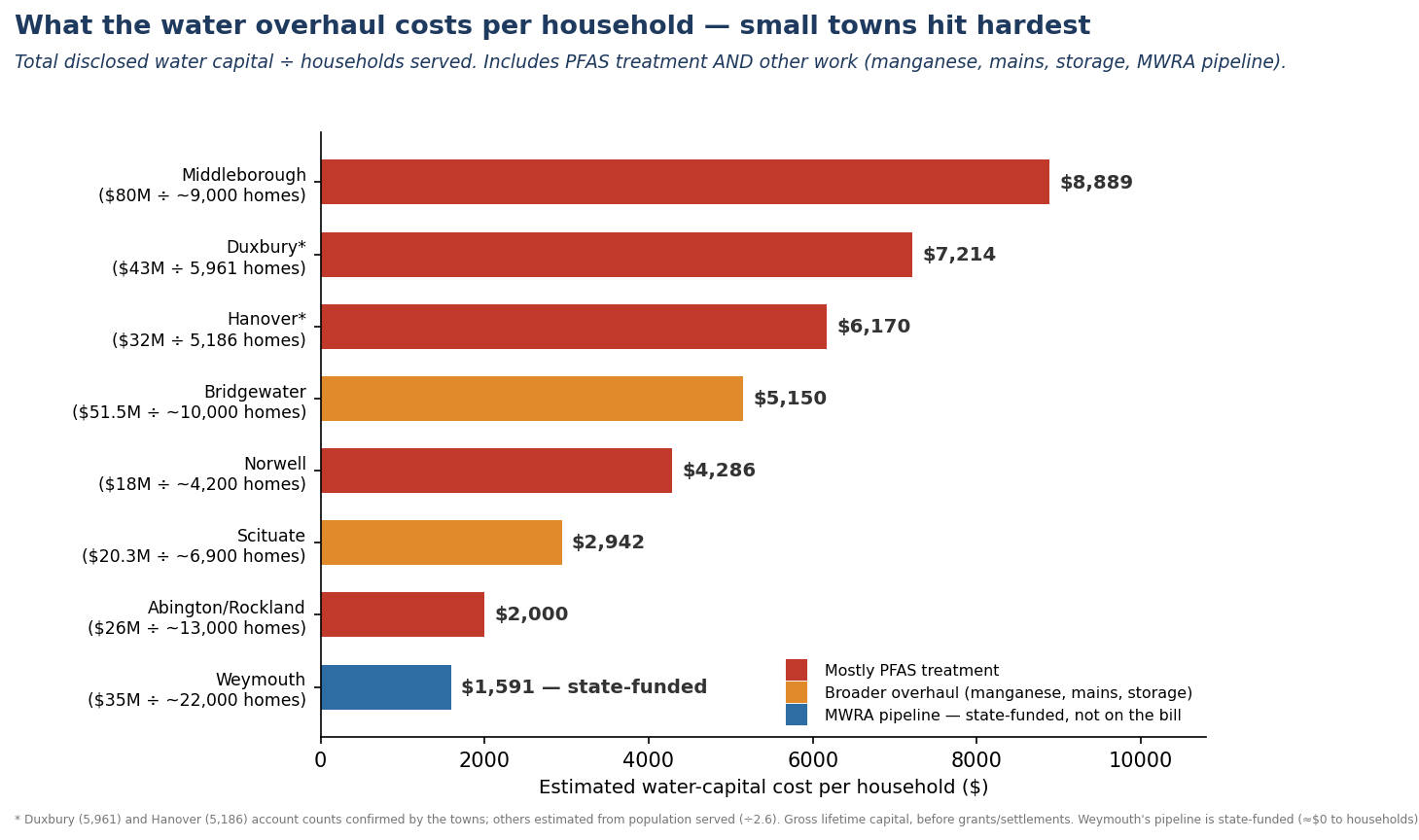
In Duxbury, the cost of PFAS has a number, and residents are about to see it on their bills. The town’s own rate study projects the average household’s annual water bill climbing from about $379 in 2025 to $823 by 2028 — more than double, and Duxbury’s first rate increases since 2010. The money will help cover a $43 million treatment plant, the first of two the town needs to scrub PFAS, iron and manganese from its wells and bring its idled Depot Street source back online.
Duxbury is not an outlier. It is just further along in saying out loud what every water department on the South Shore is now working out: getting PFAS out of the water is going to cost a fortune, and somebody has to pay for it.
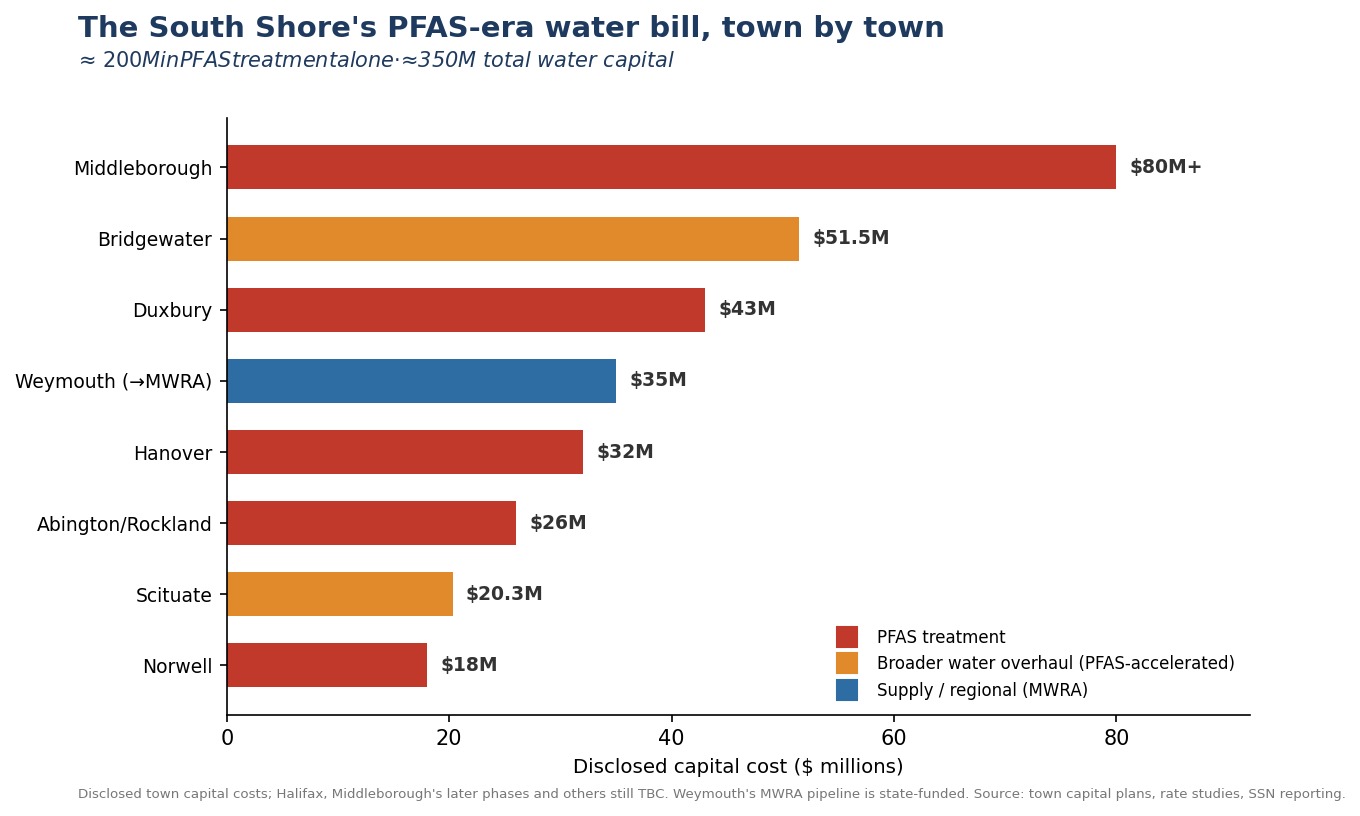
Across the region, the bills already on paper run past $200 million in PFAS treatment alone — Middleborough’s $80-million-plus plan, Duxbury’s $43 million, Hanover’s $32 million for three plants, Abington and Rockland’s $26 million, Norwell’s $18 million — and climb toward $350 million once you add the broader water-system overhauls PFAS is accelerating: Bridgewater’s $51.5 million capital plan, Scituate’s new $20 million treatment plant, Weymouth’s $35 million pivot to regional water. And Halifax is still costing its own plan out.
Who pays: three buckets, and only one of them is uncapped
The money to fix this comes from three places. Two of them are limited. The third is you.
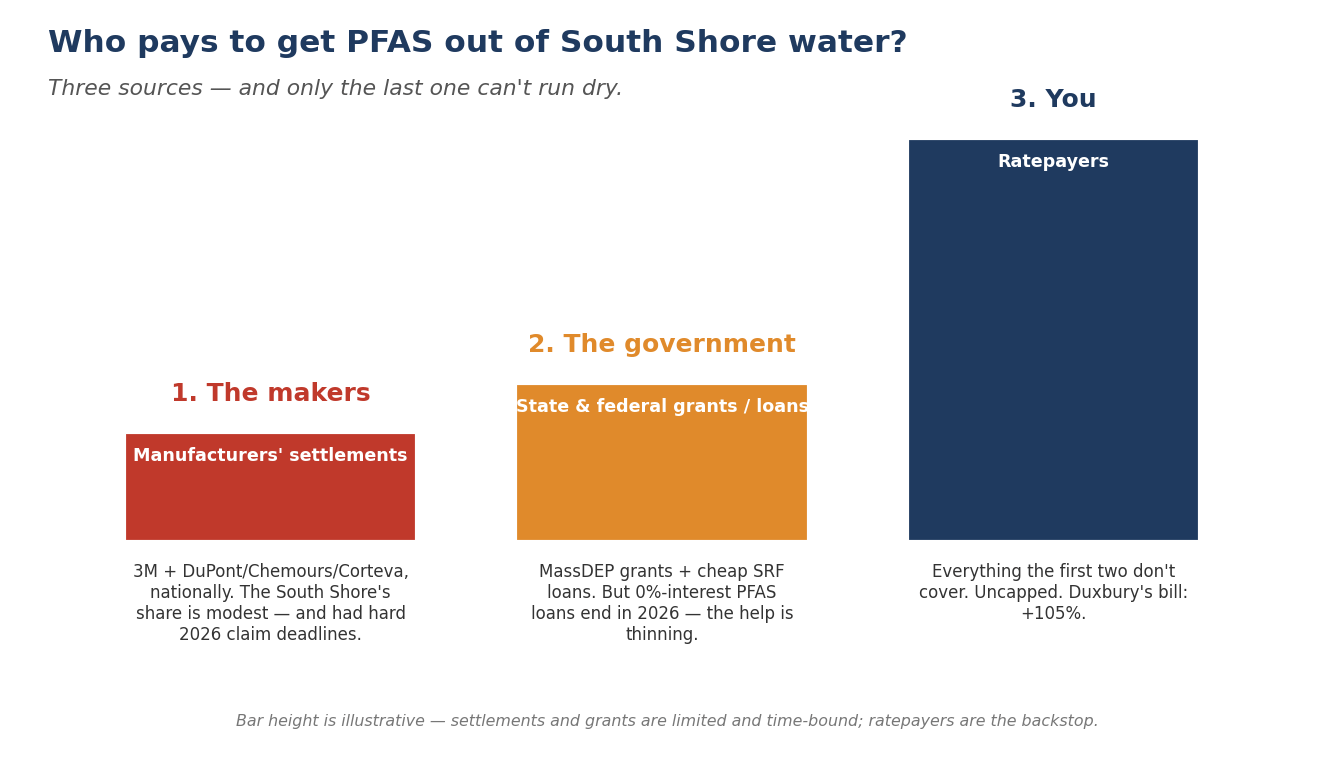
The companies that made it. PFAS didn’t appear in the aquifer by accident, and after years of litigation the manufacturers are paying into national settlements that fund water-system cleanup. 3M agreed to pay up to $10.3 billion over 13 years to public water systems; DuPont, Chemours and Corteva together added $1.185 billion. The money is parceled out system by system, by how contaminated a source is and how much water it produces — anywhere from a few hundred thousand dollars to tens of millions. (One Massachusetts town, Hudson, was told to expect about $2.9 million.) Halifax and Hanover have each confirmed receiving about $1 million so far — which appears to be the going rate for these small systems, and a modest sum against projects that run into the tens of millions.
But the money comes with a catch, and a clock. Water systems must file specific claims to collect — the DuPont fund’s deadline fell on June 30, 2026, the 3M fund’s on July 31 — and they must document their contamination source by source to qualify. Systems that miss the deadlines, or under-document, leave money on the table. Nationally, advocates have warned that hundreds of millions in settlement funds could go unclaimed.
The government. The state, using mostly federal infrastructure money, has been writing grants and cheap loans. MassDEP’s Emerging Contaminant program awarded $10.3 million to 18 water suppliers in April 2026, after $14.7 million to 21 suppliers earlier; it has set aside another $10 million to help systems plan and design treatment. And the state’s Drinking Water State Revolving Fund lends cheaply — the vehicle behind Abington and Rockland’s $26 million, interest-free loan, and Middleborough’s $33 million East Grove Street plant, which broke ground in August 2025 with a no-interest loan and 11 to 20 percent of the principal forgiven. Hanover is counting on up to $15 million in the same fund toward its $32 million project, plus small state grants — including a $25,000 Emerging Contaminant award for filter media. But even that is tightening: the state has said it can no longer offer zero-interest PFAS loans in 2026, steering other money toward partial forgiveness instead. As the cheap financing thins and the settlement deadlines pass, more of the cost slides toward the only bucket that can’t run dry.
The ratepayers. Whatever the settlements and grants don’t cover, your water bill does — and that is the bucket with no bottom. Take Hanover’s $32 million plan. About $1 million comes from the settlement and $25,000 from a state grant; the $15 million state loan still has to be paid back with interest. Strip out the roughly $1 million in genuinely outside money and ratepayers are on the hook for the rest — about 97 percent of the project, one way or another. It is the same arithmetic in every town, which is why Duxbury’s average bill is set to more than double by 2028.
And it lands hardest where there are the fewest people to spread it across. Many of these towns had held water rates flat for years — Duxbury since 2010, Halifax since 2015 — and PFAS is what finally broke the freeze.
The clock: 2029, maybe 2031
There’s a deadline driving the spending, and the federal rule it enforces works differently from the state’s. Instead of capping the sum of six PFAS compounds at 20 parts per trillion, it limits just two — PFOA and PFOS, individually, to 4 ppt each. The two aren’t a clean multiple of one another: a town whose contamination ran mostly through the other four compounds could, in theory, clear the federal bar while brushing the state limit. The compliance date is 2029; in May 2026 the EPA proposed letting systems request a two-year extension, to 2031, but that proposal is not yet final.
That theoretical loophole isn’t how the South Shore’s contamination breaks down. Here, PFOA and PFOS are the dominant compounds — and measured against the 4 ppt federal line, 16 of the 20 water systems already have one of the two above it in at least one treated source. Only Plymouth and Whitman’s Brockton-fed supply sit clearly under. So for these towns the federal limit is the binding one, and the towns comfortably “passing” the state standard today are, for the most part, on the same hook as the towns in violation — just with a few years’ head start before the 4 ppt rule forces their hand.