

First in a series examining what 22 South Shore water systems are — and aren’t — telling their customers.
Every spring, a folded report lands in your mailbox or your inbox. It’s called a Consumer Confidence Report — your water department’s annual accounting of what’s in your drinking water. Most of us skim the reassuring sentence near the top — your water meets all state and federal standards — and recycle it.
For most of the South Shore, that sentence is true. It is also not the whole story.
South Shore News spent several weeks pulling the annual water-quality reports for 22 communities — Abington, Bridgewater, Carver, Cohasset, Duxbury, East Bridgewater, Halifax, Hanover, Hanson, Hingham, Hull, Kingston, Marshfield, Middleborough, Norwell, Pembroke, Plymouth, Plympton, Rockland, Scituate, Weymouth and Whitman — and then checking them against the Massachusetts Department of Environmental Protection’s own sample-by-sample database. We focused first on the contaminant that has rewritten water budgets across the region: PFAS, per- and polyfluoroalkyl substances, the “forever chemicals.”
What we found is that the problem is real and regional — but the raw state numbers can mislead in both directions, and you can’t tell from a single annual report whether your town is delivering clean water, quietly managing a contaminated well, or sliding toward trouble.
Start in Duxbury
Duxbury draws its water from twelve wells — ten now in service — sunk into the sandy ground of the Plymouth-Carver aquifer. In the state’s raw database it posts some of the highest PFAS numbers in eastern Massachusetts — and it is also a case study in why those numbers, taken at face value, can mislead.
Massachusetts limits six PFAS compounds, measured together and abbreviated “PFAS6,” to 20 parts per trillion in drinking water. A part per trillion is a single drop in roughly 20 Olympic swimming pools; the state set the limit that low because these compounds accumulate in the body and have been linked to effects on the liver, the immune system, the thyroid, fetal development and certain cancers.
In the state’s sample database, Duxbury’s PFAS6 readings climb to 105 ppt in 2021, then 83, 73 and a peak of 142 ppt in 2024 — up to seven times the state limit. But every one of those numbers comes from a single source: the Partridge Road well, which Duxbury shut off in May 2021 because of PFAS. (A second well, Depot Street, has been offline since 2014.) The town’s ten remaining in-service wells have tested under 10 ppt, below the state limit, according to its own well-by-well testing. Duxbury did formally violate the PFAS6 standard once — in 2021, as the contamination peaked and Partridge was being pulled offline — but it has delivered compliant water since.
That distinction is the entire story, and it is invisible in the raw state data, which keeps publishing the idle well’s results under the label “finished water.” Nor is the apparent improvement what it looks like. Duxbury’s 2025 report lists PFAS6 at 9.64 ppt — but that is not the result of new treatment. “We have not put any new treatment online,” Superintendent Mark Cloud told South Shore News; the headline number fell only because offline wells drop out of compliance reporting.
The reckoning is still coming for Duxbury — in dollars. The town is designing a $43 million treatment plant, expected online around 2029, that will pair the long-idled Depot Street well with the active Tremont well and strip out iron, manganese and PFAS, bringing Depot back into service — with more treatment to follow. (A prioritization study found one of the town’s other contaminated sources, the Lakeshore Drive well, a poor site for a plant of its own.) To pay for it, water rates are set to rise 105 percent between fiscal 2026 and 2029 — the first increase since 2010. That is the real shape of the PFAS problem here: not poisoned taps today, but a town that briefly tipped into violation in 2021, pulled its two worst wells to get back under the limit, and now faces an eight-figure bill to put them back into service.
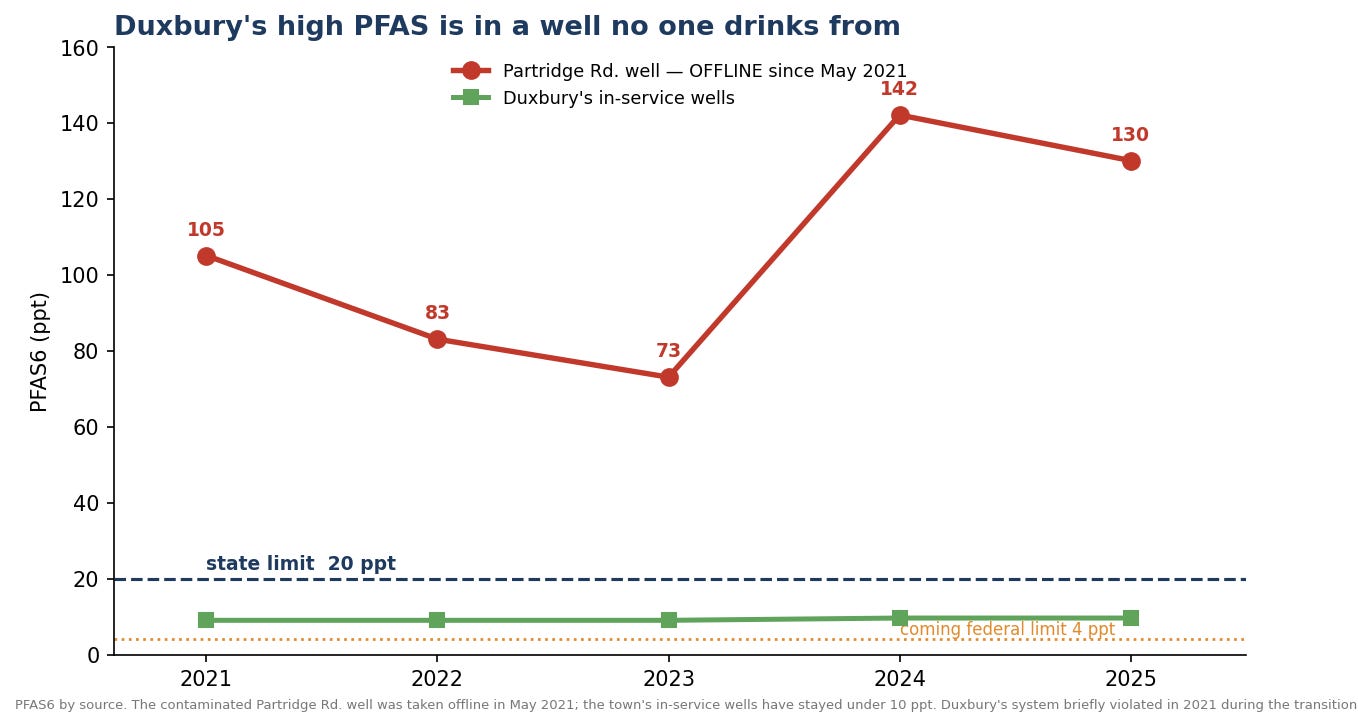
You would not learn any of that from skimming the state’s numbers — or from a single annual report. And that is the first lesson of this series: the raw data tells you where the PFAS is, not whether anyone is drinking it.
“Meets all standards” is an average, not a promise
Here is the subtlety that the word “compliance” hides. A system doesn’t violate the PFAS limit the instant one sample comes back high. Compliance is judged on a running annual average of quarterly results at each entry point to the system. A single spike can be averaged away.
That distinction cuts both ways across the South Shore.
A single high reading doesn’t trip the wire, but a sustained one does — and Norwell shows exactly how. At its Washington Street plant, one of three points where water enters the town’s distribution system, the monthly PFAS6 samples ran 21.3, 20.1 and 20.6 ppt in early 2026. Averaged, that’s 21 — over the line — and as of April 2026 Norwell is formally in violation there, issuing quarterly public notices and running a PFAS bottle-filling station at 79 Grove Street while it designs treatment. Its other two entry points, Grove and South streets, remain under the limit. That is how PFAS compliance actually works: entry point by entry point, on a rolling average — which is also why the single spikes in the state’s data don’t, by themselves, tell you whether a town is in trouble.
In other towns, the averages couldn’t save them — the contamination sat in wells still feeding the taps. Hanover formally exceeded the PFAS6 limit at its Pond Street treatment plant in 2023, by its own report. Middleborough exceeded it at its East Grove Street well, and has stayed over the line since.
None of this is visible from the front page of a Consumer Confidence Report. All of it is visible in the state’s raw data — if you know it’s there.