


EAST BRIDGEWATER — The Town of East Bridgewater is advancing a long-awaited infrastructure development along the Route 18 corridor, known as the North Bedford Street Sewer District, a project leaders hail as the key to sustainable economic growth for the community. This infrastructure initiative marks the town’s first-ever municipal wastewater system, designed to break the “septic ceiling” that has historically limited high-density commercial and industrial potential in the Metro South region.
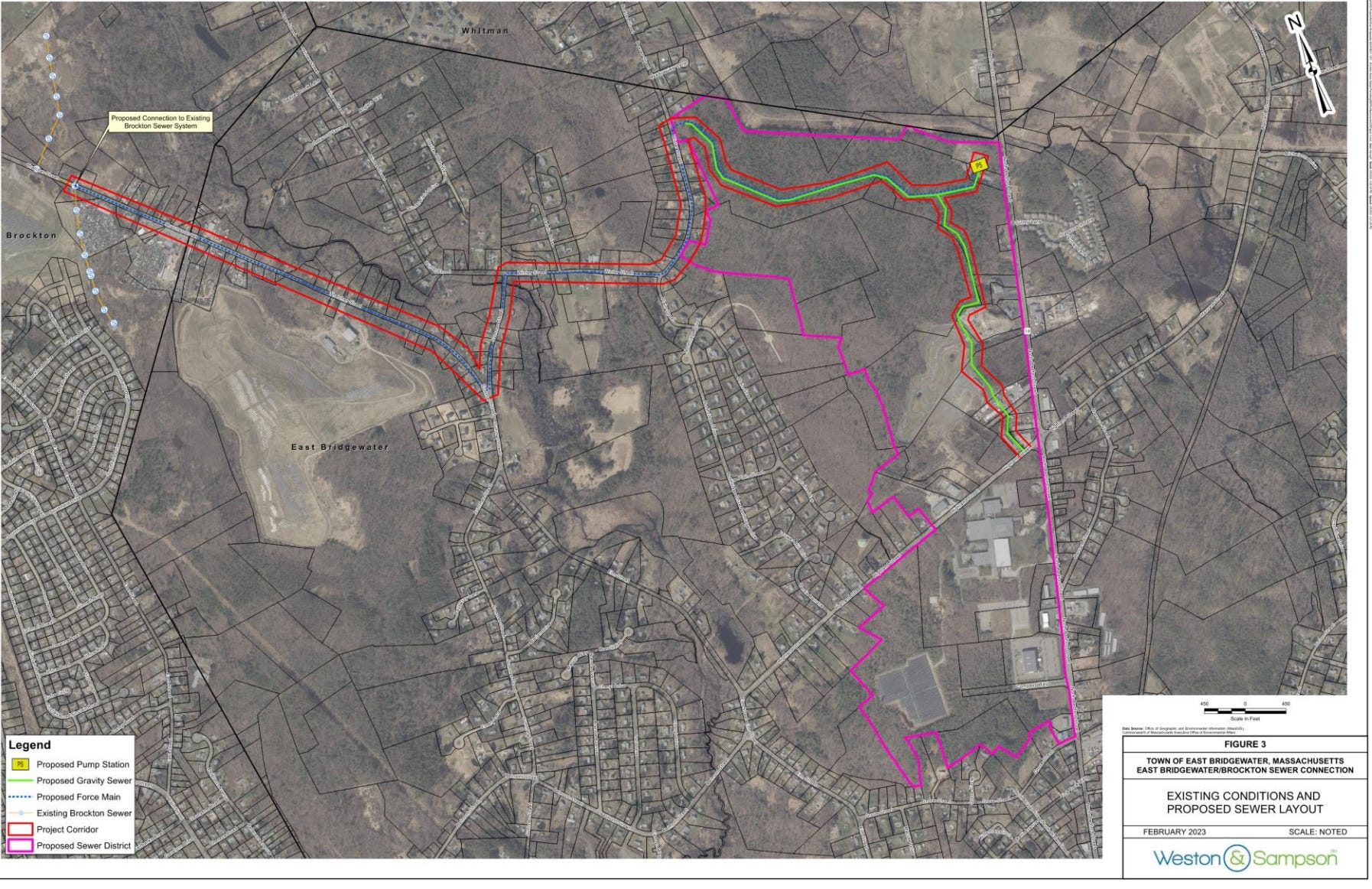
The East Bridgewater Select Board approved a $6.4 million contract with C. Naughton Corporation on June 9, 2025, for the construction of the sanitary sewer system, moving the estimated total project cost, including contingencies and oversight, to around $9.1 million—significantly less than the $11 million originally authorized.
History: A Targeted Approach to Growth
The installation of the North Bedford Street Sewer System is a direct response to the town’s geological reality: high water tables and poor soil percolation rates in Plymouth County made large-scale commercial and medical development nearly impossible without off-site wastewater treatment. For decades, economic development in East Bridgewater was governed by this hydraulic limit, which constrained the types of businesses permissible along Route 18.
The project, in development for approximately three years, involved a strategic shift from a financially prohibitive town-wide sewer expansion to a “Targeted Growth District” focused strictly on the commercial artery of Route 18 (North Bedford Street). This area runs along the west side of Route 18 from the Whitman line to Grove Street. The town successfully secured an Intermunicipal Agreement (IMA) with the City of Brockton to send up to 75,000 gallons of wastewater per day to Brockton’s Advanced Water Reclamation Facility for treatment.
The proposal was approved by Town Meeting on May 9, 2022, tied explicitly to “increasing the Town’s tax base through development”. The district was formalized by the state legislature through special legislation, Chapter 399 of the Acts of 2022. This act grants the Select Board, acting as Sewer Commissioners, “sole discretion” to determine which properties may connect and the amount of wastewater capacity allocated to each user.
Funding Model: Zero Tax Impact for Residents
A cornerstone of the project’s political viability is its unique financial model, designed to have effectively zero direct impact on the residential property tax rate.
The project financing relies heavily on grants and developer contributions, totaling approximately $7 million in non-debt funding.
• Federal and State Grants: The project secured 4 million from the MassWorks Infrastructure Program and approximately 3 million from a U.S. Economic Development Administration (EDA) grant.
• Developer Fees: The town generated additional funds through developer agreements, also known as “Privilege Fees”. The developer for the Residences at Meadow Brook, for example, contributed over $1.25 million in connection fees. The Town expects to receive between $5 million and $6 million in betterment assessments from participating development properties, which will further lower the net cost and municipal bond payments.
Town Administrator Charlie Seelig noted the immediate financial benefit, stating that the net cost of the project is “more than offset by the property taxes we’re getting from the Greystar property,” allowing the town to be ahead financially immediately. The town prioritized commercial and industrial users and explicitly avoided the process of assessing costly betterment fees against residential abutters.
Economic Development and Job Creation
Department of Public Works Director John Haines emphasized that this is the first project to provide the town with the opportunity for sustainable growth. The sewer connection directly enables three major anchor developments along Route 18, positioning the area as the “Gateway to East Bridgewater”.
1. Logistics Anchor (Jobs): The system enables the development of a massive 412,500-square-foot Class A warehouse by Greystar Real Estate Partners. This project is mandated by the EDA grant to support the creation of 400 jobs and generate $47.9 million in private investment.
2. Healthcare Anchor (Services): The sewer capacity permits expansion at the regional medical campus occupied by Signature Healthcare (formerly Compass Medical). The capacity allows for the potential addition of water-intensive services like dialysis or minor surgery centers.
3. Residential Development (Housing): The sewer system is enabling the construction of the Residences at Meadow Brook, a 240-unit housing development. Of these units, 60 (25%) will be classified as “affordable housing”. This development alone, along with the other three proposed projects, is estimated to contribute an additional $1,700,000 in property taxes each year.
The project’s scope extends beyond private development; obtaining easements for the sewer line provides access to over 30 acres of town-owned land, potentially freeing it up for future use as playing fields and recreational areas.
Overall regional economic studies suggest that sewer expansion in the Metro South area, including this district, could generate over 5,100 new regional jobs and boost business output by a projected $1.6 billion, demonstrating the power of infrastructure as economic policy. The North Bedford Street district alone is estimated to generate and sustain over 1,200 jobs.
December 22 - The Town of East Bridgewater reached a major milestone in the North Bedford Street Sewer District project during the December 22, 2025, Select Board meeting, formally signing a wastewater sewer connection agreement with Equity Industrial Southeast LLC. This deal secures a critical private funding component for the town’s first municipal sewer system and ensures immediate hookups for key commercial properties on Route 18.
Financial Breakdown of the Equity Deal
The agreement follows what Town Administrator Charlie Seelig described as a “long and winding road” of negotiations involving multiple owners of the various sections of the property.
• Total Cost Share: Equity Industrial’s estimated cost share for the project is $1,386,000.
• Immediate Funding: The company has committed to a 10% non-refundable down payment ($138,600) upon signing.
• Long-Term Commitment: The remaining balance will be paid over 25 years, matching the length of the municipal bond. This structured payment plan provides the town with a steady cash flow to help service the project debt.
Immediate Impact on Route 18 Commercial Hub
The deal specifically covers the owners of the Harte-Hanks building and the Signature Healthcare building. A significant highlight of the announcement is that Equity has committed to hooking up the Harte-Hanks building immediately once construction reaches Highland Street.
Town officials noted that having the connection operational makes these properties far more attractive for finding new leaseholders and supporting new uses. Jimmy Knight, the facilities coordinator for Equity and an East Bridgewater resident, indicated that preparations are already underway to receive the sewer line.
Project Status: Ahead of Schedule
Department of Public Works (DPW) officials delivered further good news, reporting that physical construction of the sewer system is currently about three months ahead of schedule. As crews advance toward Highland Street, the accelerated timeline suggests that the commercial “Gateway to East Bridgewater” could be fully operational sooner than the previously projected summer 2026 completion date.
Updates on Greystar and Regional Interest
The Board also received an update regarding Greystar Real Estate Partners, the developer of the massive 412,500-square-foot warehouse at 798 North Bedford Street. While Greystar is currently negotiating for additional wastewater flow to accommodate future tenants, they do not yet have a confirmed leaser for the facility. However, representatives noted that they are seeing increased “traction” and interest from potential leasers, particularly due to the site’s proximity to major highways.
This latest agreement with Equity Industrial, combined with the ongoing Greystar development, reinforces the project’s fiscal model of using developer “privilege fees” and new commercial property taxes to ensure the $9.1 million infrastructure project has zero direct impact on the residential tax rate.
Sources for this story include: the Town of East Bridgewater, Old Colony Planning Council, the Massachusetts State Legislature, South Shore News, MassWorks, US Department of Commerce EDA, and AI deep research tools.


