


HINGHAM — As Hingham approaches its April 2026 Annual Town Meeting, local decision-makers face a vote that is about far more than a building budget. The proposal to construct a new Center for Active Living (CAL) at Bare Cove Park has evolved into a complex referendum on the town’s values, pitting the undeniable demographic reality of a rapidly aging population against a fierce commitment to environmental preservation and fiscal caution.
The Landscape of Memory: A History of Bare Cove
To understand the intensity of the current debate, one must first understand the land itself. Bare Cove Park is not ordinary municipal land; it is a “palimpsest of Hingham’s history,” layering colonial agriculture, industrial warfare, and environmental reclamation.
In 1906, the U.S. Navy seized the land via eminent domain to create the Hingham Naval Ammunition Depot. By World War II, this site was a frenetic industrial city employing over 2,400 people, handling munitions for the Atlantic Fleet. It was a place of both culture—jazz legend John Coltrane played in the depot’s band—and tragedy, marked by the 1944 explosion of the USS YF-415, which killed 17 personnel.
Following decommissioning, the federal government transferred the land to Hingham in 1972 through the Federal Lands to Parks (FLP) program. The deed contained restrictive covenants mandating the property be used for “public park or public recreation purposes in perpetuity”. For decades, the town managed the majority of the 484 acres as a passive park, while designating a smaller zone for active recreation, including Lynch Field and the buildings occupied by the Fire Museum.
It is within this recreation zone, at the site of the derelict “Building 14,” that the town proposes to build its future.
The Demographic Tsunami: Why a New CAL?
Proponents argue the project is not a luxury, but a critical response to a demographic shift that has been building for decades. In 1997, residents over age 60 comprised 17% of Hingham’s population; by 2024, that number had nearly doubled to 32%, with projections reaching 39% by 2035.
Despite this shift, Hingham’s seniors are served by a facility that is widely considered inadequate. The current Senior Center, located in Town Hall, is approximately 5,500 square feet. A 2022 assessment by the UMass Gerontology Institute gave the facility failing grades, noting it lacks dedicated rooms for fitness or private health consultations and suffers from chronic parking shortages.
“The senior citizens need a home in this town,” resident Jenny Ballou told the Select Board. “The senior center will be used. It won’t be underutilized”.
Health data underscores the need. Hingham has been categorized as one of the “worst” communities in the Commonwealth regarding chronic disease metrics for older adults, driving the argument that a facility dedicated to physical and social wellness is a public health necessity.
The Project: “Use Less, Create More”
After years of study, the Center for Active Living Building Committee has put forward a plan for a 25,950-square-foot facility. The design, described as “Use Less Create More,” features a heavy timber structure intended to reflect the natural setting.
Key Project Details:
• Cost: As of January 2026, the construction estimate stands at roughly $29.9 million, a significant reduction from the $34.1 million estimate presented at the 2025 Town Meeting.
• Design: The single-story building includes a multi-purpose room with a folding partition, classrooms, an exercise studio, a café, and roughly 160 to 170 parking spaces.
• Sustainability: The building is designed to be all-electric and net-zero ready, utilizing a Variable Refrigerant Flow (VRF) heating and cooling system similar to the Public Safety Facility.
• Site Improvements: The project budget and town funds will cover a new traffic light at the park entrance, a water line extension for fire protection, and the repaving of Bare Cove Park Drive.
The Path to Bare Cove: Why Here?
The selection of Bare Cove Park was a process of elimination. The committee held 47 public meetings and evaluated multiple sites before settling on the Building 14 location.
• Town Hall: Rejected due to insurmountable parking deficits and structural limitations preventing necessary expansion.
• 17 Union Street: Rejected because the 11-acre parcel is largely wetlands, sits in a high-yield aquifer district, and lacks sewer access.
• Beal Street (Hitchcock Shoes): Rejected due to the high cost of acquiring private commercial real estate and the property being under contract at the time of review.
The committee selected the Building 14 site because it is already “disturbed land”—a former munitions storage site containing hazardous materials like asbestos and lead paint that the project would remediate.
The Case for the HCAL: A Public Health Imperative
Proponents argue that the Center for Active Living is a “vital foundational resource” for the community, necessary to combat the detrimental health effects of isolation, which the Surgeon General has equated to smoking 15 cigarettes a day.
1. Meeting Unmet Demand Supporters point to neighboring Marshfield as a case study. After expanding their center to a similar size, Marshfield saw participation triple, serving nearly 4,000 individuals annually. Currently, Hingham seniors are forced to travel to other towns for basic programs; Dick Ponte, a resident, noted that 20 to 25 Hingham residents drive 30 miles to Marshfield weekly just to play duplicate bridge because Hingham lacks the space. “I am often embarrassed to say that I live in Hingham because when I go to these other senior centers... they are amazed that a town like ours does not have a decent place for our seniors,” Ponte stated.
2. Fiscal Value and Efficiency Despite the sticker price, advocates argue the project represents fiscal prudence. The programming budget for the center is currently zero dollars—funded entirely by grants, donations, and fees—a model that will continue in the new facility. Regarding the tax burden, resident Glenn Mangurian calculated that for the median homeowner, the project would increase taxes by approximately $210 annually—a figure supporters deem reasonable for a 50-year facility that serves a third of the population.
3. Strategic Design The design team emphasizes that the chosen site allows for a single-story, accessible building that integrates with nature rather than destroying it. The building utilizes “bird-safe” glazing to protect wildlife and is positioned to remediate an existing hazardous site (Building 14), replacing a derelict structure with a net-zero ready community hub.
The Case Against the HCAL: Environmental and Financial Risk
Opponents, while often supporting the concept of a senior center, argue that the specific proposal for Bare Cove Park is legally perilous, environmentally damaging, and fiscally irresponsible.
1. Environmental Degradation Critics view the project as an ecological disaster for a sensitive area. “When you cut down five acres of trees, it’s loss of habitat for all the birds that are there,” argued Hillary Hosmer, noting the site is within a migration route and Area of Critical Environmental Concern (ACEC). Opponents contend that fragmenting the forest with a building and 160 parking spots disrupts the “island biogeographic theory,” preventing species from reproducing and effectively turning a wildlife preserve into a “backyard”.
2. Legal Vulnerability A major point of contention is the 1972 federal deed. Anita Ryan warned the Select Board that the federal government retains the right to “reclaim this land if Hingham breaches any conditions of the grant,” specifically the requirement for public use in perpetuity. Opponents argue that a membership-based senior center may violate these covenants, risking a reversion of the land to federal ownership—a scenario that has occurred with other parcels in the past.
3. Fiscal “Want vs. Need” With a total project cost hovering around $30 million, critics question the expenditure amidst other looming capital needs, such as a $10 million unfunded backlog for roads and schools. “I don’t think the number of people who will use the [new senior center] justifies the expense,” said resident Peter Goldstein, categorizing the facility as a “want” rather than a “need” when compared to competitive salaries for town employees or school upgrades. Furthermore, skeptics argue that $7 million in site preparation costs alone makes the location fiscally inefficient compared to adaptive reuse of existing buildings.
The Decision
As Hingham moves toward the April 27, 2026, Town Meeting, the choice is stark. Voters must weigh the pressing social and health needs of a third of their population against the sanctity of conservation land and the preservation of Hingham’s “landscape of memory”.
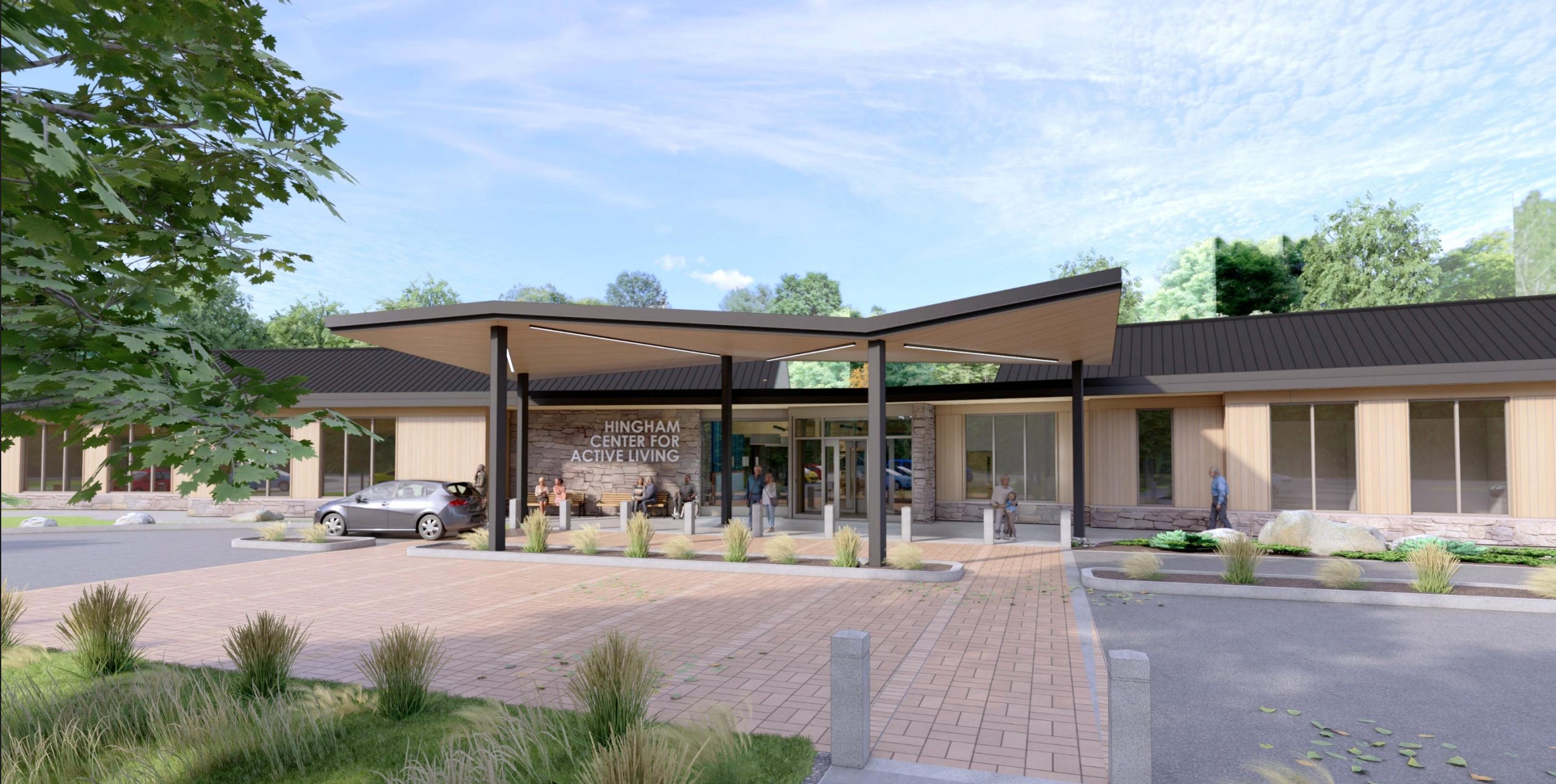
If the project fails to secure a two-thirds majority, the town faces an uncertain path forward, with no clear alternative site and a senior population that continues to grow. If it passes, construction is targeted to begin in Summer 2026, promising a new era for Hingham’s older adults, but forever altering the entrance to Bare Cove Park.
Sources include: South Shore News, Hingham Anchor, South Shore Times, the Town of Hingham Center for Active Living Building Project website, Invest in Hingham, Harbor Media recordings, Zoom meeting recordings obtained by Public Records Request, and AI Deep Research tools.


