


To understand the political earthquake that just hit Quincy, Massachusetts, you first have to understand the city’s psychology. This is the “City of Presidents,” the birthplace of John Adams and John Quincy Adams. It is a place where history is revered, where public monuments are sacred, and where Mayor Thomas Koch has reigned with near-absolute authority for eighteen years.
For nearly two decades, Koch—a devout Catholic and former Democrat turned Independent—operated with a compliant City Council that approved his agenda 99% of the time. But in 2023, he made a decision that would eventually threaten his political capital, invite a constitutional lawsuit, and leave two ten-foot bronze figures gathering dust in a warehouse.
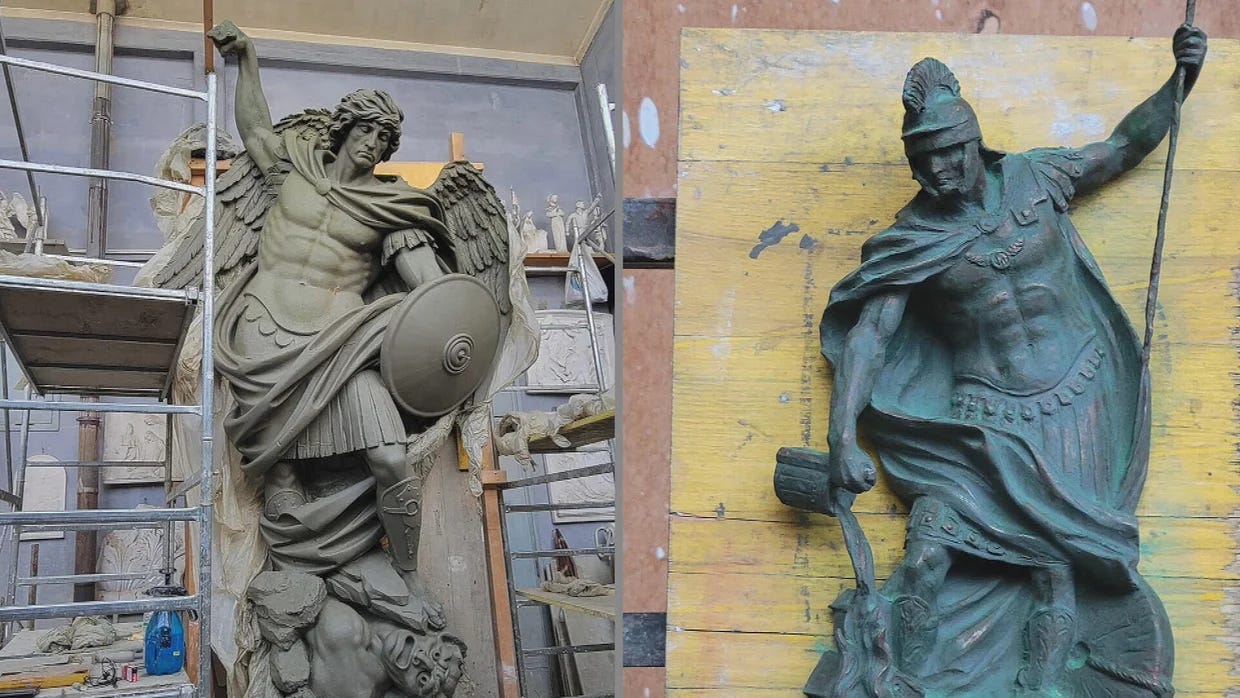
Here is the story of the “Saint Statues” scandal, how a secret $850,000 commission collided with the separation of church and state, and why it cost the Mayor his grip on the city.
The Secret Commission
The controversy centers on the new Public Safety Headquarters, a massive $175 million infrastructure project designed to house the police and fire departments. For years, the project was sold to the taxpayers and the City Council as a utilitarian upgrade—a necessary modernization for emergency responders.
However, behind closed doors and without public oversight, Mayor Koch decided the building needed a spiritual centerpiece. In 2023, he quietly commissioned Sergey Eylanbekov—a sculptor who had previously crafted the city’s statues of John Adams and John Hancock—to create two colossal bronze statues for the building’s entrance.
The subjects were not secular figures of justice or civic duty. They were Saint Michael the Archangel and Saint Florian, the Catholic patron saints of police and firefighters, respectively.
The fatal flaw was not necessarily the art, but the process. The $850,000 price tag was buried within the larger construction budget. There were no public hearings. The City Council, which holds the purse strings, was never shown renderings of the saints. As Koch’s own chief of staff later admitted, the Mayor “dreamed up and commissioned the saintly adornments all by himself”.
The Revelation and the “Violent” Imagery
The secret held until February 2025, when The Patriot Ledger broke the story. The reaction was immediate and combustible. Residents were stunned to learn that nearly a million dollars of taxpayer money had been spent on religious iconography while the city faced a staggering $1.6 billion in debt and rising property taxes.
The controversy quickly moved beyond finances to a debate about the imagery itself.
• Saint Florian was depicted pouring water on a burning building—a fairly standard tribute to firefighting.
• Saint Michael, however, became a lightning rod. The statue depicts the Archangel in a “triumphant” pose, brandishing a spear and stepping on the neck of a defeated demon.
In the post-2020 climate, following the murder of George Floyd, the image of a uniformed authority figure (or its spiritual proxy) stepping on the neck of a humanoid figure struck many as deeply tone-deaf. Councilor Dan Minton, a retired police officer himself, publicly objected, arguing that the “violent” imagery was inappropriate for a modern police station and that he didn’t want citizens associating that aggression with local officers.
The Constitutional Crisis
Mayor Koch attempted to defend the statues by arguing they were “secular” symbols. He claimed that Michael and Florian had transcended their theology to become “heroic” icons of the police and fire subcultures. He insisted they represented “truth and justice, good over evil,” rather than Catholic doctrine.
A coalition of Quincy residents disagreed. Represented by the ACLU of Massachusetts and other civil liberties groups, fifteen plaintiffs from diverse faith backgrounds (including Jewish, Protestant, and Atheist residents) filed a lawsuit, Fitzmaurice v. City of Quincy.
Their argument was rooted in Article 3 of the Massachusetts Declaration of Rights—authored by Quincy’s own John Adams—which offers even stricter protections against the “subordination of any one sect” than the U.S. Constitution. The plaintiffs argued that forcing victims of crime or witnesses to walk beneath “looming religious imagery” to access government services created a psychological barrier, effectively signaling that non-Catholics were outsiders.
In October 2025, the legal hammer dropped. Superior Court Judge William Sullivan issued a preliminary injunction blocking the installation. His ruling was a dismantling of the Mayor’s logic. Judge Sullivan wrote that it was “impossible to strip the statue of its religious meaning to contrive a secular purpose,” noting that an objective observer would view the statues as an endorsement of Catholicism.
The Political “Perfect Storm”
If the statues had been the only issue, Mayor Koch might have weathered the storm. But the scandal became the tipping point in a “referendum on the mayor’s governance”.
Throughout 2025, a narrative of arrogance and fiscal mismanagement began to stick to the administration.
1. The Raise: While defending the $850,000 statues, Koch pushed for a 79% salary increase for himself, which would have made him one of the highest-paid mayors in America.
2. The Rhetoric: In the heat of the controversy, Koch gave a radio interview where he characterized the Catholic Church’s sexual abuse scandals as “mostly homosexual issues,” a comment that alienated the LGBTQ+ community and abuse survivors.
3. The Debt: The juxtaposition of “luxury” religious art against the city’s financial strain painted a picture of an administration out of touch with reality.
The Fallout: A New Day in Quincy
The consequences arrived on Election Day, November 4, 2025. In a city where incumbents rarely lose, the voters delivered a stunning rebuke.
Five of the Mayor’s reliable allies on the City Council were ousted. They were replaced by a wave of challengers who had campaigned specifically on transparency and checking executive overreach. The new council includes the city’s first Chinese-born councilor and now holds a veto-proof supermajority against the Mayor.
Anne Mahoney, a long-time critic of the Mayor, topped the ticket and was elected Council President, signaling a complete shift in power. As one observer noted, “The statues were wrong. The way we’re spending money is wrong”.
Where We Stand Now
As of early 2026, the statues of Saint Michael and Saint Florian sit in a storage facility in Randolph, banned from entering Quincy by court order.
However, the fight isn’t over. The Massachusetts Supreme Judicial Court (SJC) has agreed to hear the case, bypassing the lower appeals court. The SJC will decide a critical question: Should Massachusetts follow the federal government’s recent shift toward allowing “historical” religious displays, or should it maintain its strict constitutional wall between church and state?.
For Mayor Koch, the damage is done. He remains in office, but his “King of Quincy” status has evaporated. He now faces a hostile City Council that views the statues not as art, but as a monument to a style of secret, unilateral governance that the city has firmly rejected. The bronze saints were meant to be a legacy project; instead, they became the wedge that broke the administration apart.
Sources include: Massachusetts Court records, The Patriot Ledger, The Boston Globe, GBH, WBUR, The Quincy Sun, The Boston Herald, A Just Quincy substack, and AI Deep Research tools.


