

Massachusetts holds its state primary on Tuesday, September 1. Across the nineteen towns South Shore News covers, most offices on the ballot are uncontested — the candidate listed is the only candidate listed, and the September vote is a formality. A handful are not.
This is a plain accounting of which races are actually contested, who is on the ballot, which towns vote in each one, and what the money looks like. Every candidate name below comes from the Secretary of the Commonwealth’s certified primary candidate lists, which are the legal ballot.
How to vote
Primary day: Tuesday, September 1. Polls generally open 7 a.m. to 8 p.m.; check your town clerk for local hours.
Register by: Saturday, August 22, 5 p.m. — online, in person, or postmarked by that date.
Early voting: Saturday, August 22 through Friday, August 28. Hours are set town by town.
Vote by mail: Applications must reach your clerk by 5 p.m. Tuesday, August 25. Massachusetts mails an application to every registered voter roughly 45 days out.
One thing that trips people up every cycle: Massachusetts runs a semi-closed primary. If you’re enrolled in a party, you get that party’s ballot. If you’re unenrolled — which describes the majority of South Shore voters — you may choose either ballot, but you must choose one, and you can’t split between them. You cannot vote in the Democratic Senate primary and the Republican governor’s primary. Taking a party ballot does not enroll you in that party.
Statewide races every South Shore voter sees
U.S. Senate — Democratic primary
Edward J. Markey (Malden, incumbent) vs. Seth Moulton (Salem)
This is the only contested race on the Democratic ballot in all nineteen towns. Markey has held the seat since 2013 and won the state party’s endorsement at the May convention. Moulton has represented the 6th District since 2015 and is running explicitly on generational change.
The money has run against the incumbent. Moulton raised roughly $1.4 million in the second quarter of 2026 to Markey’s $1 million — the second consecutive quarter Moulton has out-raised him. Public polling has been less consistent: a UMass Amherst/WCVB poll in late 2025 put Markey up 51–28 among likely Democratic primary voters, while Moulton’s campaign has circulated more recent surveys showing a single-digit race. Markey has led every independent public poll released to date.
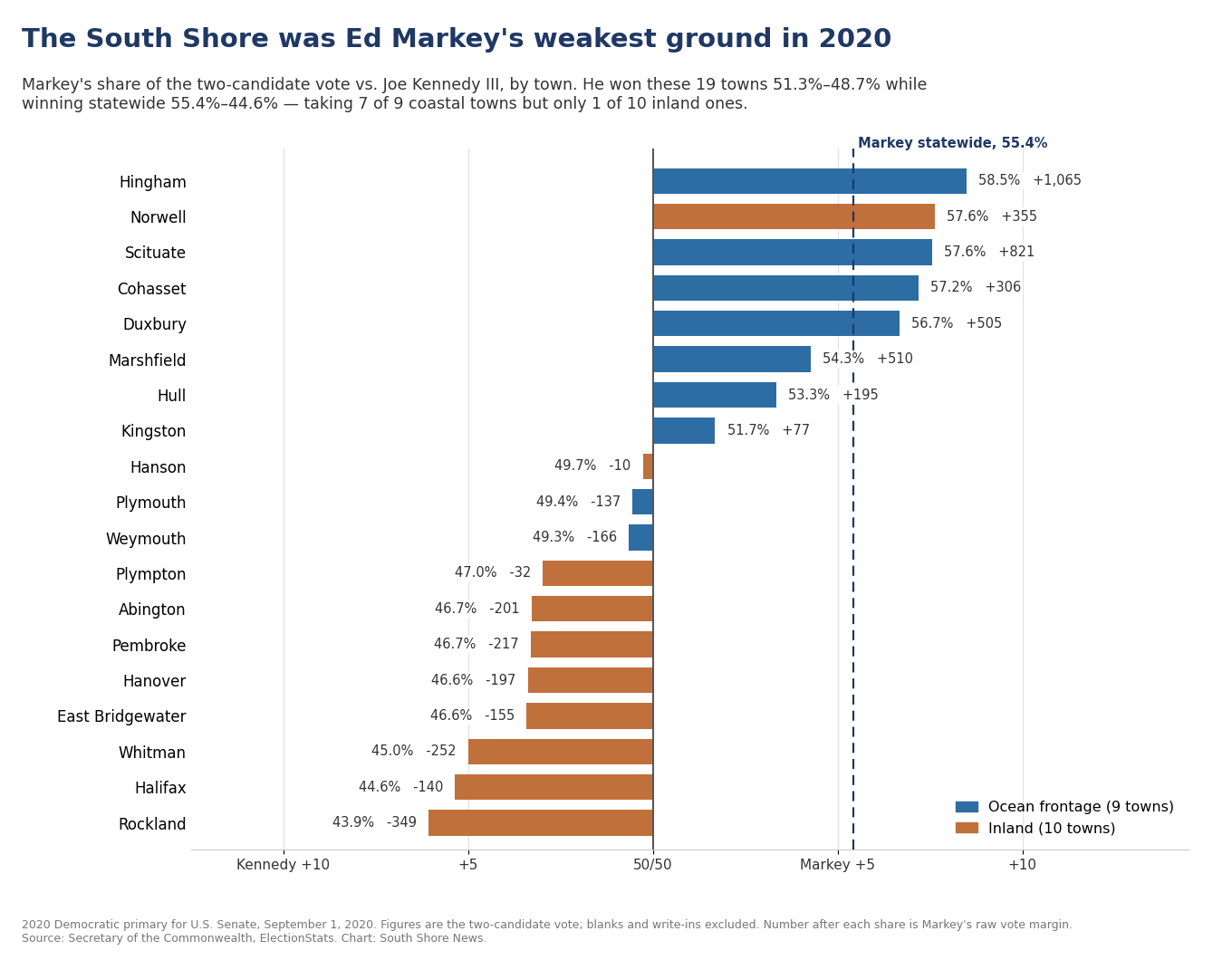
The local number that matters: the South Shore was Markey’s weakest ground the last time he faced a serious primary. In the 2020 Markey–Kennedy race — also decided on a September 1 primary — Markey won statewide 55.4 percent to 44.6 percent. Across these nineteen towns he won just 51.3 percent to 48.7 percent, a margin of 1,978 out of 76,540 votes cast for the two candidates.
The split was geographic and close to clean. Of the nine coverage towns with ocean frontage, Markey carried seven. Of the ten inland towns, he carried one — Norwell. His two coastal losses were Plymouth and Weymouth, the largest and most working-class of that group, and both were within 170 votes. Rockland gave him his worst result anywhere in the coverage area, 43.9 percent.
That is the map Moulton is running on. The inland tier — Rockland, Halifax, Whitman, East Bridgewater, Hanover, Pembroke, Abington, Plympton, Hanson — is where a challenger running against a long-tenured incumbent has found purchase here before.
The winner faces Republican John Deaton, who is unopposed for his party’s nomination.
Governor — Republican primary
Michael Roger Minogue (Hamilton) vs. Brian Shortsleeve (Barnstable)
Minogue, the former CEO of the Danvers medical device firm Abiomed, took 70.4 percent of the delegate vote at the April 25 Republican convention. Shortsleeve, a former MBTA chief administrator and acting general manager, cleared the 15 percent threshold with 15.5 percent. Former Baker administration housing secretary Mike Kennealy finished at 14.11 percent, failed to qualify for the ballot, and later endorsed Minogue.
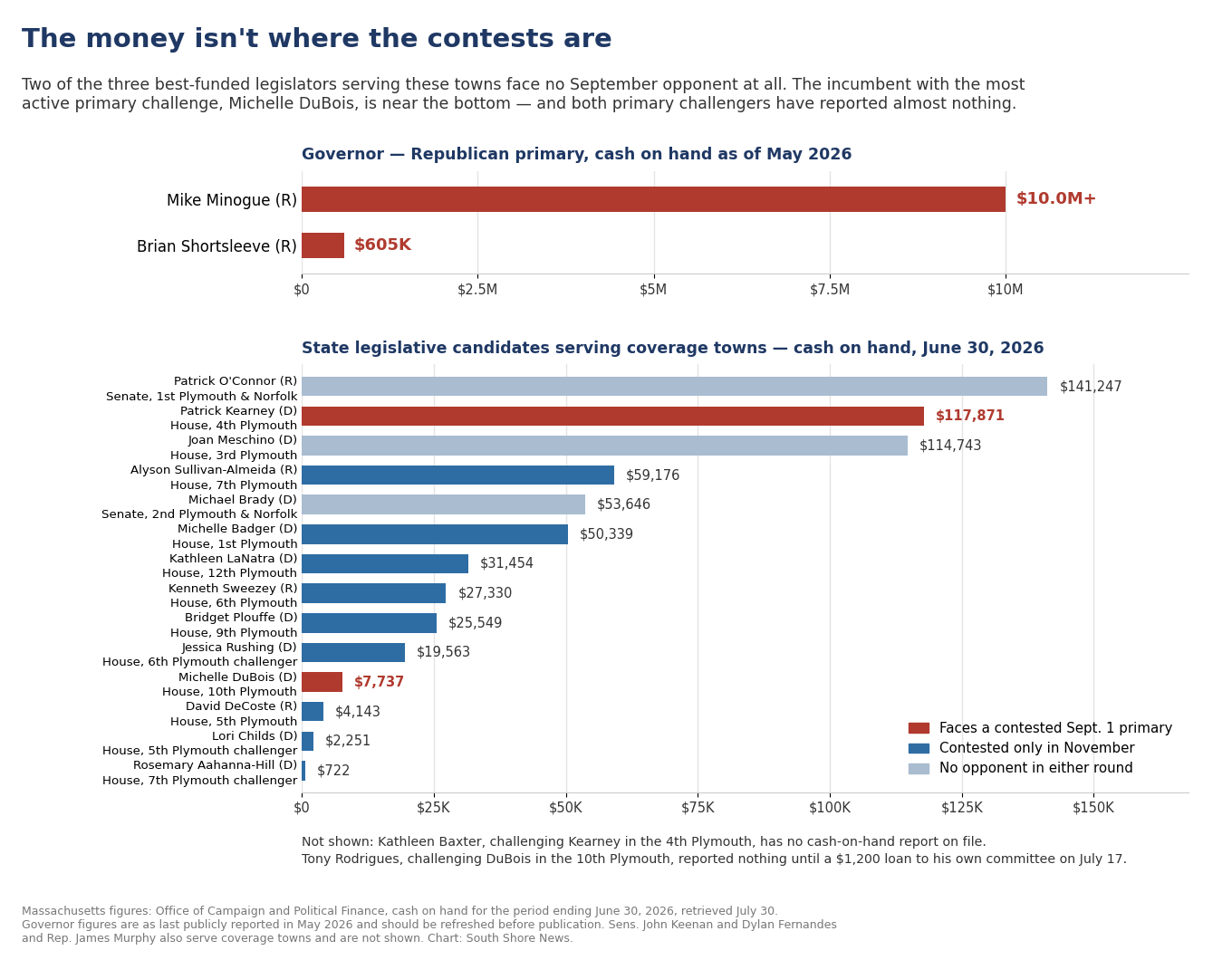
The financial gap is the largest in any race on this ballot. Minogue raised more than $7.5 million in the first quarter of 2026 — $7 million of it his own money — against roughly $646,500 for Shortsleeve. As of May, Minogue reported more than $10 million cash on hand to Shortsleeve’s roughly $605,000. His self-funding prompted a state lawmaker to file legislation restricting the practice.
South Shore turnout carries real weight here. These towns include some of the heaviest concentrations of registered Republicans in eastern Massachusetts, and in a low-turnout statewide primary a few thousand votes out of Hanover, Norwell, Marshfield, Duxbury and Pembroke are not a rounding error.
Governor Maura Healey is unopposed on the Democratic ballot.
Lieutenant Governor — Republican primary
Shawn Oliver (New Bedford), unopposed
Massachusetts nominates governor and lieutenant governor separately, then runs the winners as a ticket in November. Shortsleeve has campaigned alongside Oliver.
This was expected to be a contested race. Ann Manning Martin, a Peabody city councillor, was removed from the ballot in July. The State Ballot Law Commission struck 1,279 of the 10,692 signatures she filed — some allegedly copied from a public voter list, others in the names of people who had died — leaving her short of the 10,000 certified signatures the office requires. The challenges were brought by Oliver and by the state Democratic Party’s executive director, and the allegations center on a contractor Manning Martin hired to gather signatures rather than on the candidate personally.
Manning Martin denies wrongdoing and called the ruling manifestly unjust. She appealed to Essex County Superior Court and lost after two days of hearings; on July 14, Supreme Judicial Court Justice Frank M. Gaziano upheld her removal. Because a number of the disputed signatures were collected on the South Shore, local election officials were drawn into the review.
Lieutenant Governor Kim Driscoll is unopposed on the Democratic ballot.
Congress
The nineteen towns split between two congressional districts. Both incumbents drew a Democratic primary challenger; both Republican primaries are uncontested.
8th District — Democratic primary
Stephen F. Lynch (Boston, incumbent) vs. Patrick Thomas Roath (Boston)
Voting: Abington, East Bridgewater, Hingham, Hull, Weymouth, Whitman
Lynch has held the seat since 2001 and runs on seniority, constituent service and building-trades support. Roath, a voting-rights attorney and former Deval Patrick aide, is running to his left, has declined corporate PAC money, and has out-raised the incumbent. Roath reported raising $600,551 in 2025 to Lynch’s $381,835, and FEC filings through March 31, 2026 show Roath at $888,691 against Lynch’s $542,308. Roath has been endorsed by Patrick, the Boston Teachers Union, and David Hogg’s Leaders We Deserve PAC. Lynch retains the union institutional backing that has carried him for twelve terms.
Robert Gerald Burke (Dedham) is unopposed on the Republican ballot.
Note: Ballotpedia lists a third Democrat, Andrew Zylberfink, in this race. He does not appear on the Secretary’s certified list and will not be on the ballot.
9th District — Democratic primary
Bill Keating (Bourne, incumbent) vs. Craig Swallow (New Bedford)
Voting: Cohasset, Duxbury, Halifax, Hanover, Hanson, Kingston, Marshfield, Norwell, Pembroke, Plymouth, Plympton, Rockland, Scituate
Keating has held the seat since 2011. Swallow is a low-profile challenger who has not mounted a visible campaign in the South Shore portion of the district. This is a contested race in the technical sense and is very likely to be a lopsided one.
R. Tyler MacAllister (Mattapoisett) is unopposed on the Republican ballot.
Governor’s Council, 4th District — Democratic primary
Christopher A. Iannella, Jr. (Boston, incumbent) vs. Ronald Primo Iacobucci (Quincy)
Voting: Abington, Cohasset, Duxbury, Hanover, Hingham, Hull, Marshfield, Norwell, Rockland, Scituate, Weymouth
The Governor’s Council confirms every judge, clerk magistrate and Parole Board appointment in Massachusetts. It is the least-covered elected body in state government and one of the more consequential. Iannella has held this seat since 1993. Iacobucci has run the MassHire South Shore Career Center for more than two decades.
This is a rematch. In the 2024 primary Iannella took 56.4 percent, community-reentry advocate Stacey Borden took 32.2 percent, and Iacobucci finished third with 11.2 percent — but his vote was concentrated in Quincy, where he took 3,071 votes, a third of the city’s total. With Borden out of the race, the question is whether her 23,884 votes were anti-incumbent votes available to Iacobucci or Boston-specific support that stays home.
The arithmetic of this district is worth stating plainly. In 2024, Boston cast 41,552 of the 83,511 votes in this primary — 49.8 percent. The eleven South Shore News towns in the district cast 20,947, or 25.1 percent. South Shore voters do not decide this seat on their own, but a quarter of the electorate in a race almost nobody covers is meaningful leverage.
No Republican filed. The September primary decides the seat.
The eight remaining SSN towns — East Bridgewater, Halifax, Hanson, Kingston, Pembroke, Plymouth, Plympton and Whitman — fall in Governor’s Council districts with no contested Democratic primary.
State Legislature
Of the fourteen state House districts and four state Senate districts touching South Shore News towns, exactly one has a contested primary in a town we cover.
4th Plymouth District — Democratic primary
Patrick Joseph Kearney (Scituate, incumbent) vs. Kathleen Ann Baxter (Scituate)
Voting: Marshfield, most of Scituate, and part of Norwell
This is the only contested legislative primary on the ballot in an SSN town, and it is a rare thing on the South Shore: a sitting Democratic state representative drawing a primary challenger from his own hometown.
The financial picture is one-sided. As of the June 30 reporting date, Kearney reported $117,871 cash on hand and $48,925 raised year-to-date, against $22,949 spent. Baxter has not reported a comparable war chest, $1,904 at the last filing.
Baxter has not run a visible public campaign to date: no forums, endorsements, or press coverage have surfaced in Marshfield, Scituate or Norwell since her filing. That is itself the story worth reporting out — a primary challenge to a well-funded incumbent that has generated no observable campaign activity six weeks from the election.
No Republican filed. The September primary decides this seat.
10th Plymouth District — Democratic primary
Michelle Marie DuBois (Brockton, incumbent) vs. Tony Andrade Rodrigues (Brockton)
Voting: Brockton wards 4, 5 and 6 — no South Shore News town votes in this race
This one is not on your ballot. We’re covering it because it borders the coverage area, because Brockton’s delegation votes on the same regional water, transportation and housing questions our towns do, and because it is the closest thing to a competitive legislative primary in the region.
DuBois has held the seat since 2015. Rodrigues is the Ward 4 member of the Brockton School Committee. No Republican filed, so the September primary decides the seat.
The money is unusually thin on both sides. As of the June 30 filing, DuBois reported $7,737 cash on hand and $10,596 raised year-to-date — a smaller war chest than most South Shore incumbents are carrying, and less than a tenth of what Patrick Kearney holds two districts away. Rodrigues had shown almost no financial activity until July 17, when he lent his own committee $1,200. That loan is the first hard evidence that this is a real campaign rather than a paper filing.
Everything else
Every other legislative district serving these towns has one candidate per party in September. Several of them have real November general elections, and those are the races to watch after Labor Day:
1st Plymouth — Plymouth. Michelle Badger (D, incumbent) vs. David Golden Jr. (R), a member of the Plymouth Select Board.
3rd Plymouth — Hull, Hingham, Cohasset. Joan Meschino (D, incumbent) is unopposed in both rounds.
4th Norfolk — Weymouth. James Murphy (D, incumbent); no Republican filed.
5th Plymouth — Hanover, Rockland, Norwell, Hanson. David DeCoste (R, incumbent) vs. Lori Childs (D), vice chair of the Rockland Select Board.
6th Plymouth — Duxbury, Halifax, Hanson, Marshfield, Pembroke. Kenneth Sweezey (R, incumbent) vs. Jessica Rushing (D) of Pembroke.
7th Plymouth — Abington, Whitman, East Bridgewater. Alyson Sullivan-Almeida (R, incumbent) vs. Rosemary Aahanna-Hill (D) of Whitman.
9th Plymouth — part of East Bridgewater. Bridget Plouffe (D, incumbent) vs. Lawrence Novak (R). A 2024 rematch.
12th Plymouth — Kingston, Plympton, Plymouth, Halifax, Pembroke. Kathleen LaNatra (D, incumbent) vs. Eric Meschino (R). Also a 2024 rematch.
State Senate: all four districts serving SSN towns are uncontested in September.
1st Plymouth & Norfolk (Cohasset, Duxbury, Hingham, Hull, Marshfield, Norwell, Scituate, Weymouth): Republican Patrick O’Connor is unopposed. The Democratic line reads “No Nominations” — no Democrat filed. O’Connor faces no major-party opponent in November. He reported $141,247 cash on hand as of June 30.
Norfolk & Plymouth (Abington, Hanover, Rockland): Democrat John Keenan is unopposed; no Republican filed.
2nd Plymouth & Norfolk (East Bridgewater, Halifax, Hanson, Whitman): Democrat Michael Brady is unopposed; no Republican filed. He reported $53,646 cash on hand.
Plymouth & Barnstable (Kingston, Pembroke, Plymouth, Plympton): Democrat Dylan Fernandes and Republican Kari MacRae are each unopposed and meet in November. This is the most competitive general-election Senate seat in the coverage area.
Where the money actually is
Put those names against their bank balances and a pattern emerges: the safest seats hold the biggest war chests. The two best-funded legislators serving these towns, Patrick O’Connor and Joan Meschino, have no opponent in either round. The incumbent facing the most active challenge, Michelle DuBois, is near the bottom of the list. Both primary challengers have reported almost nothing.
The scale gap is worth sitting with. Every candidate in the lower panel holds about $656,000 between them. Mike Minogue, on the same ballot, is sitting on roughly fifteen times that by himself.
County offices
Plymouth County Commissioner — Republican primary
Sandra M. Wright (Bridgewater, incumbent) vs. Anthony Thomas O’Brien, Sr. (Pembroke) vs. Korey Michael Welch (Rockland)
Voting: all seventeen Plymouth County towns in the coverage area — everywhere except Cohasset and Weymouth
This is the most contentious race on the local ballot and the one with the least statewide attention. The three Republicans met at a WATD forum in Marshfield on July 20 and clashed over commissioner compensation, the county’s handling of roughly $200 million in federal pandemic relief, and what Welch described as a “uniparty alliance” between Wright and the commission’s lone Democrat.
O’Brien, a former commissioner, has centered his campaign on commissioner pay, citing roughly $40,000 in annual stipend plus up to $25,000 in health benefits for a body that meets once or twice a month. Wright, a commissioner since 2011, points to a county that had a $1 million deficit and unfinished audits when she arrived and now runs a $1.5 million surplus with no debt. Welch, a former Rockland selectman, has taken a middle position on pay and a sharper one on governance.
Democrat Rhonda Nyman (Hanover) is unopposed on her side.
Norfolk County District Attorney — Democratic primary
Jim Barakat (Braintree) · Gregory P. Connor (Milton) · Adam W. Deitch (Quincy) · Robert Louis Jubinville (Milton) · Macy Lee (Milton) · Craig J. MacLellan (Cohasset) · Djuna Elizabeth Perkins (Dedham)
Voting: Cohasset and Weymouth
Seven Democrats are running for an open seat. DA Michael Morrissey, first elected in 2010, announced on January 12 that he would not seek reelection. The race has been shaped almost entirely by the Karen Read prosecutions and the Sandra Birchmore investigation, and by the question of how the office handles allegations of law-enforcement misconduct. Connor spent 25 years as a prosecutor in the office and resigned in March to run; Deitch is a former federal prosecutor; MacLellan was elected to the Cohasset School Committee in 2019.
No Republican filed. The September primary is effectively the election, though an independent candidacy in November remains possible.
Uncontested county races
Plymouth County District Attorney Timothy J. Cruz (R, Marshfield) is unopposed for renomination and no Democrat filed. Plymouth County Register of Probate Matthew McDonough (D, Marshfield) and County Treasurer Thomas J. O’Brien (D, Plymouth) are likewise unopposed with no Republican filed.
Town by town
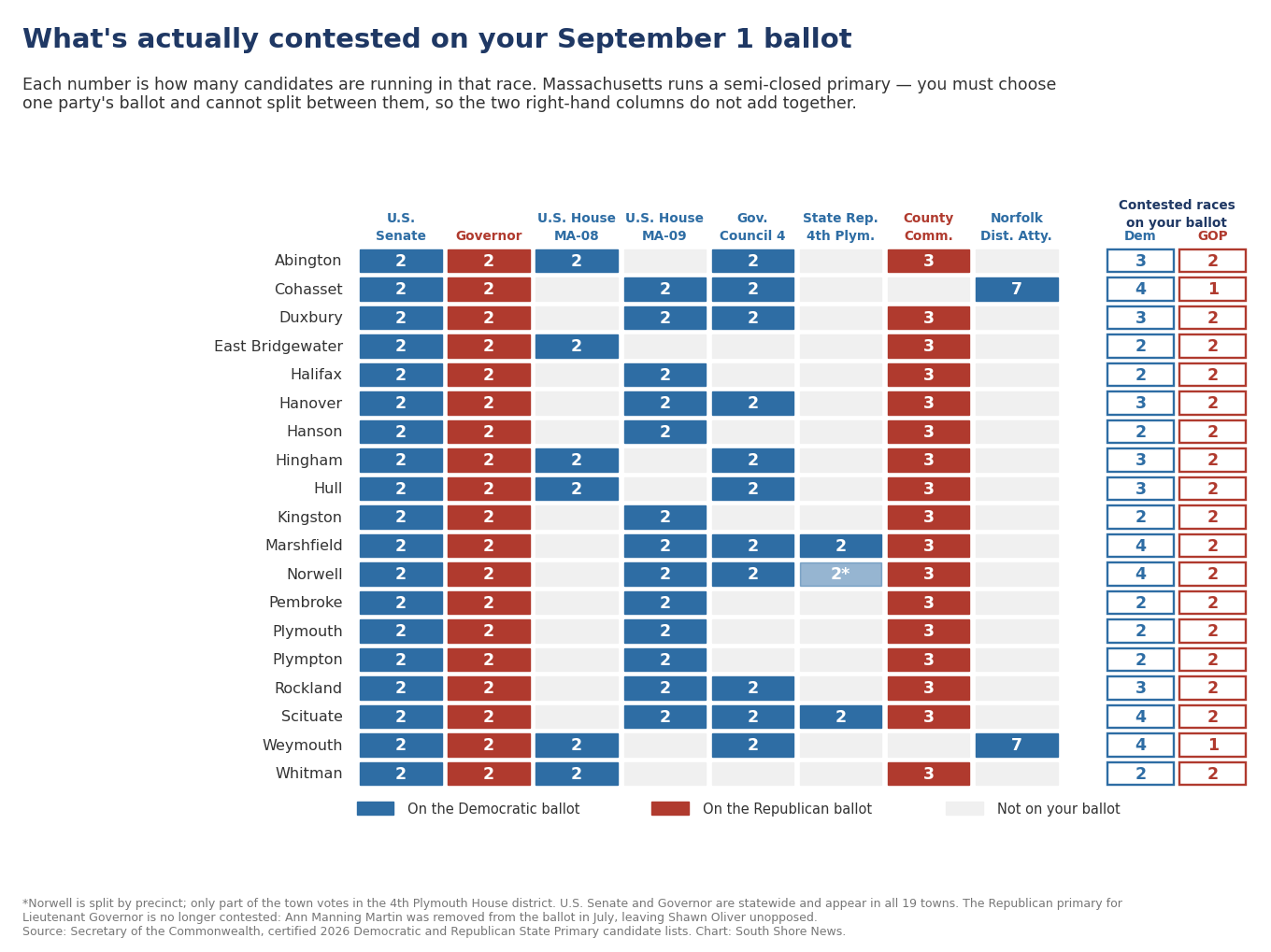
Several towns are split by precinct between districts. Voters unsure of their assignment should use the Secretary’s district lookup or call their town clerk — particularly in Norwell, Marshfield and Scituate, where the 4th Plymouth House line runs through town.
Looking past September: nine questions in November
The Elections Division assigned numbers to nine statewide ballot questions on July 21 — the most since 1994. Most ballots will run two to three pages. None of these are on the September ballot, but the campaigns are already running.
Expanding the Public Records Law — subjecting the Legislature and governor’s office to the public records law
Collective bargaining for CPCS employees — allowing public defenders to unionize
State primary elections — replacing party primaries with a single top-two primary
Election Day registration
State revenue limit and rebate
Natural Resource Conservation Fund
Single-family homes — lot-size zoning
Prohibiting retail sale of adult-use marijuana
Firearms regulation — a veto referendum on the 2024 gun law
Not on the ballot, despite heavy earlier coverage: the rent control and income tax reduction petitions, which the Supreme Judicial Court struck.
A note on sourcing
Candidate names, spellings, home towns and ballot status in this report come from the Massachusetts Secretary of the Commonwealth’s certified 2026 Democratic and Republican State Primary candidate lists. Those lists are the legal ballot and supersede Ballotpedia, Wikipedia and other aggregators, several of which still carry withdrawn or non-certified candidates in the Senate, governor and MA-08 fields.
Massachusetts campaign finance figures are from the Office of Campaign and Political Finance, reported as of the June 30, 2026 filing date and retrieved July 30. Federal figures are from FEC filings and campaign disclosures as cited. 2020 and 2024 election results are from the Secretary’s ElectionStats database.
If you spot an error in this guide, tell us and we’ll correct it.
Thank you!