

MARSHFIELD - August 24 - The sharpest and longest exchange of Monday night’s WATD radio forum between U.S. Rep. Bill Keating and Democratic primary challenger Craig Swallow came not over health care or immigration, but over money — specifically, whether a member of Congress who sits on the House Armed Services Committee should own or trade stock at all. Swallow, a New Bedford activist making his first run for office, pressed Keating to sell his holdings before the September 1 primary and accused the eight-term incumbent of trading in industries he helps regulate. Keating, who said his investments are handled by a third-party manager he does not direct, called the attack “a little expedient” and pointed to his co-sponsorship of legislation restricting congressional stock trading.
The Full Story
The hour-long forum, moderated by Christine James with questions from WATD reporter Tom Gorman and Monday Night Talk host Kevin Tocci, was broadcast live from the station’s Marshfield studio and streamed by media partners The Local Seen and PACTV. Gabriella Bethany kept time. The winner of the September 1 Democratic primary will face Republican R. Tyler MacAllister in the November 3 general election for the 9th Congressional District.
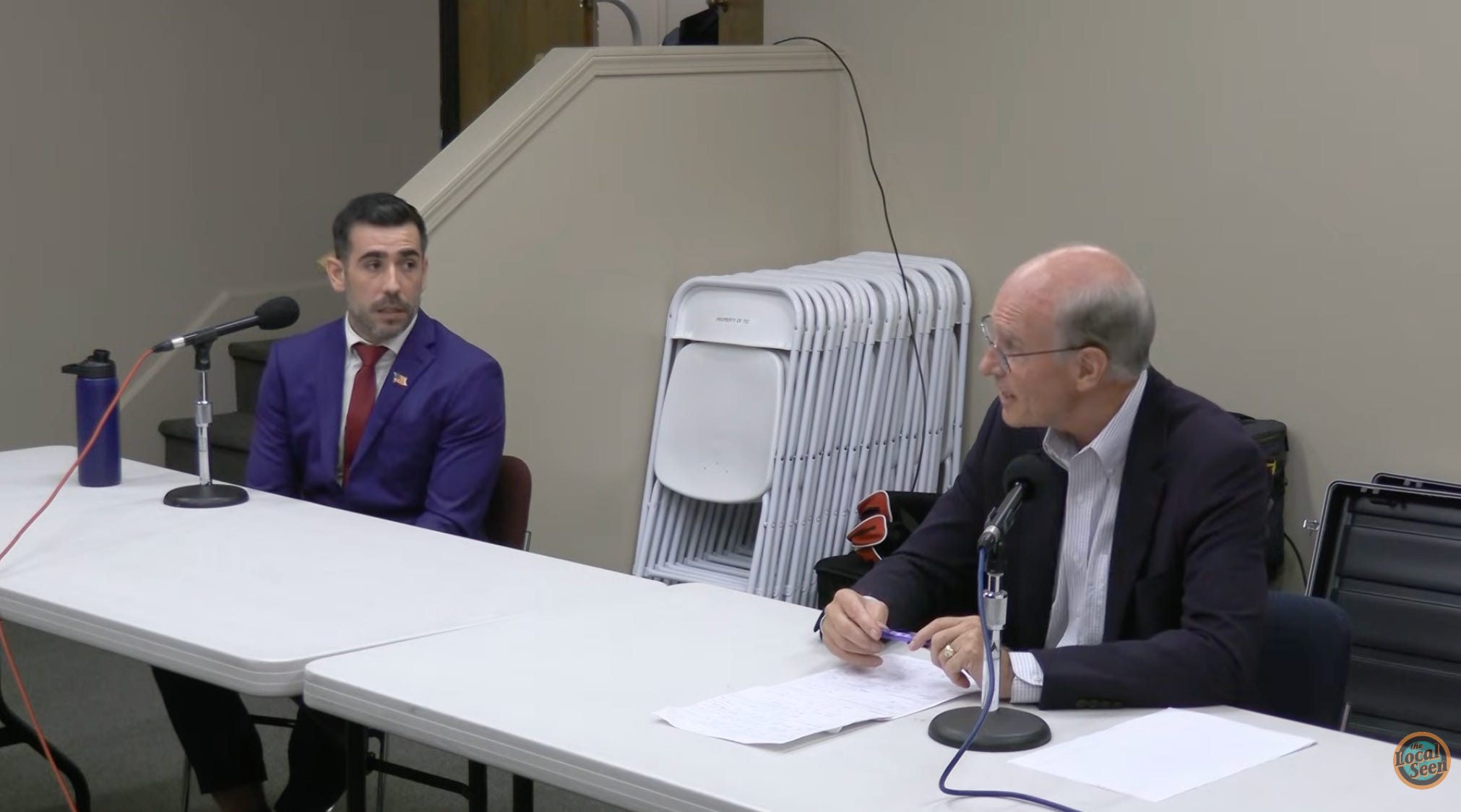
The two men set out the terms of the race in their opening statements. Keating, first up, framed the election around what he called “the crisis of affordability” and argued that the job is largely one of accessible, unglamorous local delivery. He listed emergency room expansion at Beth Israel Deaconess, clean water upgrades and preserved affordable housing in Carver, a community center in Pembroke, childcare in Plymouth, first responder equipment in Norwell and Cohasset, Green Harbor dredging in Marshfield, seawall construction in Scituate, and wastewater work in Plymouth and Rockland. “These are the issues that are important,” he said. “That’s why I think it’s a vital part of my job.”
Swallow, 40, a former New Bedford High School history teacher and restaurant manager who co-led the South Coast chapter of Indivisible before stepping down in January to run, said his own household budget is his qualification. He described rising deductibles and prescription costs, said he would refuse PAC money and stock trading, and pledged to confront surveillance technology firms including Flock Safety, OpenAI and Palantir over government contracts. “We’re going to hear a lot tonight about experience as opposed to Keating’s resume as opposed to my experience,” he said. “I believe my experience is exactly what we are missing in Congress right now.”
The confrontation over money in politics began with a two-part question from Tocci: what would each candidate do to reduce the influence of corporate money and lobbyists, and should members of Congress be prohibited from owning or trading individual stocks?
Keating answered first. “Like so many people in my district, I have retirement funds that are managed by third parties,” he said. “Even the person I speak with doesn’t even pick the stocks. It’s done by a committee.” He said he supports and co-sponsors legislation to prohibit congressional stock trading, but argued the larger danger is unregulated outside spending. He called for overturning Citizens United and, at a minimum, requiring super PACs to disclose their donors, warning that such groups “will come in with days left in a campaign and overwhelm the whole fundraising” of a race. He cited cryptocurrency money as a recent example and predicted artificial intelligence money would follow.
Swallow used his two minutes to draw a personal contrast. “I’m the only one sitting here who’s not accepting any PAC dollars,” he said, describing a “political integrity pledge” he has signed. He said he would not trade individual stock as a member of Congress and dismissed the third-party-manager explanation directly: “Saying that a third-party intermediary handles your stocks is not acceptable. I have third-party intermediaries handling my stocks too.” He then challenged the incumbent on the air: “You could just sell your stock, and I have called on you to sell all your stock before the primary. Just show that you are not going to be part of the system. It takes nothing.”
Keating responded that Swallow was singling him out while supporting other members of Congress who also hold and trade stocks, and said a ban should be applied “across the board the way it should” through legislation. Swallow returned to the point twice more, sharpening it into the exchange’s most quotable line: “Just because something is legal doesn’t make it right. We would tell children that just because you can do something doesn’t make it right.”
Swallow then made the evening’s most specific factual charge, saying Keating “traded Boeing stock in 2024 the day before a DOJ investigation,” and contrasted the congressman’s disclosure obligations with the stricter restrictions his husband faces working for a Boston software company. He named Lockheed Martin, Raytheon and Northrop Grumman as the category of holdings he objects to: “You’re not trading in just any random individual stock. You are trading stock in the industries that you are drafting legislation for.”
Keating replied that insider trading is already a crime, that members disclose their holdings, and that his investments are conservative and not directed by him. “I’m not doing the trading,” he said. “It’s done by a third party.” He added that “all PACs are not that bad either,” noting endorsements from the Equality PAC, which advances LGBTQ+ issues, and from labor unions. Swallow, who is gay, said he welcomed the Equality PAC’s work but that his objection was to defense-industry money, “not labor unions.”
A Second Flashpoint: ICE and the Plymouth Facility
The forum’s other heated moment came over immigration enforcement. Keating said he supports “deconstructing ICE” because the agency “has lost its mission,” citing detentions of people who are here legally and have not been convicted of crimes, and said he has visited the Plymouth County Correctional Facility and spoken with detainees.
Swallow said that was insufficient, calling for the agency to be abolished and replaced with a service modeled on the former Immigration and Naturalization Service. He said Keating had described conditions at the Plymouth facility as adequate after other members of the Massachusetts delegation had called them inhumane. Keating disputed the characterization, saying his colleagues’ comments about acceptable conditions referred to the state-run house of correction itself, not to ICE’s practices. “What’s not acceptable is taking away a human’s freedom,” he said. “That’s what’s cruel.”
The two men then talked past each other in the night’s most personal exchange. “I was inside. I saw it,” Keating said. “My colleagues were inside. They saw it. I wasn’t outside looking in.” Swallow, who said he walked a pilgrimage from Provincetown to Plymouth to draw attention to the facility, answered: “I was standing with activists in my community.” He also said Plymouth County Sheriff Joseph McDonald Jr. should step down if inhumane treatment is occurring at the facility.
Health Care, Energy and Infrastructure
On health care, Keating said he believes Medicare for All will happen “eventually” and that the immediate priority is reversing Republican cuts. He said roughly 10,000 people in the district rely on Affordable Care Act premium support and warned that a 60-year-old couple earning $85,000 could face a premium increase of nearly $10,000 a year.
Swallow seized on the word “eventually.” Noting that Keating has said he would support Hakeem Jeffries for speaker and that Jeffries has not made single-payer a priority, Swallow said: “We cannot have people waving the white flag before they’re even in the majority.” He cited a recent Yale study estimating that Medicare for All would save about $1 trillion a year and more than 100,000 lives, and said he would press Jeffries to make it a top priority. Asked how a single-payer system would be financed, Swallow argued that eliminating private insurance would lower total costs and that displaced insurance workers could be absorbed into administering the new system. Keating said a larger risk pool mixing younger and older enrollees, administered through Medicare, would reduce costs over time.
On energy, the candidates diverged in framing. Keating blamed federal policy, saying his district alone has spent about $160 million more on gas since the start of the war and that the administration has paid offshore wind developers to abandon projects that had been built up in the district. Swallow declined to make the president the centerpiece of his answer. “I have no interest in constantly blaming Donald Trump for everything,” he said, noting that “monopolies like Eversource existed before Donald Trump came into power.” He called for breaking up utility monopolies and for subpoenaing fossil fuel companies’ communications and creating a superfund for affected communities. He had opened the night with a household example: “$5 worth of gas usage and $130 worth of delivery fees. That is literally from my Eversource bill this month.”
On infrastructure, Gorman asked how each would secure funding for the Bourne Bridge now that Sagamore money is in hand. Keating described working across the aisle in the minority to move the Sagamore grant through subcommittee and said, “These things don’t happen by magic.” Swallow said he would be equally willing to work with Republicans but would communicate with constituents throughout the process rather than announcing a result months later, and pushed for regional transit connections across the district, including bus service linking New Bedford, Plymouth and Falmouth.
On foreign policy, both said the United States should hold Israel accountable; Swallow said a genocide is occurring in Palestine and that the U.S. should stop funding weapons transfers, while Keating pointed to his co-leadership with Rep. Pramila Jayapal of a resolution on humanitarian abuses in Gaza. Keating said he had told Defense Secretary Pete Hegseth in committee that strikes off the coast of Venezuela amounted to war crimes, and said he was one of a handful of Democrats to vote against the National Defense Authorization Act in committee. “Bombs aren’t going to settle the Iranian war,” he said. “Diplomacy will.” Swallow said the U.S. should remain engaged in Ukraine but disengage from Israel, Iran and Venezuela, and noted that the Defense Department has been unable to pass an audit.
Asked to name their priorities, the two returned to their opening themes. Keating said affordability comes first, followed by preserving the alliances he works on as a member of the Foreign Affairs Committee; if Democrats take the majority, he said, he expects to chair the Europe subcommittee again. Swallow named universal health care first, then banning congressional stock trading and PAC contributions “by just not doing it,” and added term limits for both Congress and the Supreme Court. “People who are incumbents have the financial and name recognition that upcomers never will have,” he said. Keating replied that Swallow supports long-serving members elsewhere, including the state’s own senators.
Key Exchanges
Opening statements — Keating on the “crisis of affordability” and district-level project delivery; Swallow on middle-class experience, PAC money and surveillance technology. (Timestamp: 00:02:02 – 00:06:15)
Health care and Medicare for All — including the exchange over Hakeem Jeffries and the word “eventually.” (Timestamp: 00:09:02 – 00:12:55)
Energy costs and climate — Eversource, offshore wind and fossil fuel accountability. (Timestamp: 00:13:05 – 00:17:43)
Immigration and ICE — the Plymouth County Correctional Facility exchange. (Timestamp: 00:22:02 – 00:27:06)
Social Security — both candidates endorsed lifting the payroll tax cap. (Timestamp: 00:27:06 – 00:31:06)
Corporate money and stock trading — the forum’s longest and most contentious segment. (Timestamp: 00:31:07 – 00:38:14)
Infrastructure and the Cape Cod bridges (Timestamp: 00:38:37 – 00:43:26)
Israel, Palestine and U.S. military posture (Timestamp: 00:43:26 – 00:48:24)
Lightning round and closing statements (Timestamp: 00:50:46 – 00:54:35)
Lightning Round
Biggest mistake Washington is making: Keating — the national debt, citing $3 trillion added by the Republican budget law. Swallow — “They’re blaming everything on Trump.”
Should the federal income tax be simplified: Both answered yes.
Higher taxes on the wealthiest Americans to fund affordability programs: Both answered yes.
Country you’d choose as ambassador: Swallow — Portugal, where he holds dual citizenship. Keating — Ireland, where his grandparents were born.
Favorite book: Swallow — Dry by Augusten Burroughs. Keating — To Kill a Mockingbird.
Bucket list item: Swallow — a new surround sound system. Keating — “a few moments again with my parents,” who are deceased.
What’s Next
The Democratic primary is Tuesday, September 1, 2026. Early voting ends August 28.
The winner faces Republican R. Tyler MacAllister, a former Mattapoisett Select Board member, in the November 3 general election.
Full recording available via PACTV and The Local Seen.
Fact Check
Swallow: A Yale study found Medicare for All would save $1 trillion and more than 100,000 lives. Accurate. A Yale-led analysis reported in mid-August 2026 — roughly ten days before the forum — estimated annual savings of more than $1 trillion and more than 114,000 lives saved per year. Swallow’s characterization of both the findings and the timing holds up.
Swallow: Keating “traded Boeing stock in 2024 the day before a DOJ investigation.” Substantially accurate, with important context. Keating’s disclosures show a sale of Boeing shares valued between $1,001 and $15,000 on February 28, 2024, and a Boeing corporate note valued between $15,001 and $50,000 earlier that month. Reporting that the Justice Department had opened a criminal investigation into Boeing surfaced the following day. Keating’s office said at the time that a third-party financial adviser made the trades independently and that the congressman learned of the February sale while preparing his disclosure filing. No wrongdoing has been alleged by any authority.
Keating: More than 70 percent of people ICE detains have not committed a serious crime. Supported. An analysis of internal ICE booking data by the Cato Institute, published in November 2025, found that 73 percent of people booked into ICE custody in the fiscal year beginning October 2025 had no criminal conviction at all, and that 5 percent had a violent conviction.
Swallow: Keating called conditions at the Plymouth facility adequate after Markey, Pressley, Lynch and McGovern called them inhumane. Partly verifiable; the central claim about Keating could not be confirmed. Reps. Ayanna Pressley, Jim McGovern and Stephen Lynch did conduct an unannounced oversight visit of the Plymouth ICE facility on August 14, 2026, and Sens. Elizabeth Warren and Ed Markey have separately pressed the Department of Homeland Security over what they called abysmal conditions there. South Shore News could not locate a statement in which Keating described conditions as adequate. At the forum, Keating said his colleagues’ comments about acceptable conditions referred to the state-run house of correction rather than to ICE’s treatment of detainees.
Keating: The Social Security payroll tax cap is “about $186,000.” Close. The 2026 Social Security taxable maximum is $184,500. Keating flagged the estimate himself as possibly off “by a little bit.”
Keating: A 60-year-old couple earning $85,000 would see premiums rise by $9,950; the average person faces a 50 percent premium increase. Directionally supported; the figures could not be independently verified for this district. KFF’s national analysis of expiring enhanced ACA tax credits estimates average out-of-pocket premium payments would rise 114 percent — from $888 to $1,904 a year — and its national illustration for a 60-year-old couple at $85,000 is an increase of more than $22,600 a year. Because Massachusetts premiums and benchmark plans differ from national averages, a lower district-specific figure is plausible.
Keating: The administration spent “$257 billion” paying offshore wind companies to stop production. Incorrect as stated. The federal payments to cancel offshore wind projects have been reported in the billions, not hundreds of billions. Bloomberg reported roughly $4 billion in total payments as of August 6, 2026, including about $1.22 billion to the German utility RWE. The figure Keating cited appears to be a misstatement of scale.
Swallow: He would support “H.R. Resolution 4899,” which bans PAC dollars accepted by candidates. Unverified. The measure that most closely matches Swallow’s description is the Ban Corporate PACs Act, H.R. 4799. The discrepancy may be a misstatement. 4899 is the CANADA act related to exemptions from some tariffs.
Keating: A congressional stock trading ban awaits a Democratic majority. Needs context. The STOCK Act, enacted in 2012, requires disclosure of trades but does not prohibit them. A separate bill barring members, spouses and dependent children from buying new stocks passed the House 232–198 on July 22, 2026 — a Republican-led measure that only 13 Democrats supported after GOP leaders attached a voter photo-ID requirement that Democrats called a poison pill. That bill is stalled in the Senate. Keating’s office has said he co-sponsors legislation to bar stock trading by the president, vice president and members of Congress.
Keating: $2.3 billion for the Sagamore Bridge. Close, and consistent with the follow-up question. MassDOT puts the Sagamore replacement at about $2.13 billion within a $4.5 billion two-bridge program, with roughly $1.72 billion in federal funds secured. The Bourne Bridge replacement, estimated at $2.37 billion, does not yet have finalized funding — the premise of Gorman’s question.
Swallow: Keating said in-person town halls are “a thing of the past.” Accurate. Keating used that phrase in recent interviews, saying he has expanded to three district offices and favors smaller and online events. He held one traditional town hall in the past six years, in March 2025.
Context on Medicare for All: Keating framed single-payer as something that will happen “eventually.” He is also listed as a co-sponsor of the Medicare for All Act in this Congress — a point neither candidate raised during the exchange.
Keating: The Equality PAC has endorsed him. Accurate. Keating appears on the Equality PAC’s list of endorsed allies for 2026, though the group’s website lists his district incorrectly as MA-10.