


If you stood in the center of Whitman or Brockton in the early 1900s, the dominant sound wouldn’t be the roar of car engines, but the hum of electric wires and the clang of trolley bells. During World War I, Massachusetts boasted a spectacular infrastructure oddity: its electric interurban and streetcar network was so incredibly dense that its 3,056 miles of track actually outpaced standard steam railroad mileage.
At the heart of this web sat the South Shore, where electric trolleys defined how people worked, lived, and played. Here is the story of the rise, peak, and inevitable fall of the South Shore streetcars, and how they forever shaped the region.
The Rise: An Industrial Imperative
The South Shore streetcar boom began in the late 1880s and 1890s, not as a scenic amenity, but out of sheer industrial necessity. Brockton was booming as “Shoe City,” and surrounding towns like Whitman, Abington, and Rockland were filled with massive footwear, leather, and tack factories.
While steam trains existed, they were far too expensive and their schedules too infrequent for daily, local commuting. A new solution was needed to move the thousands of working-class citizens between their homes and the assembly lines. Local business leaders began chartering electric streetcar lines, such as the Whitman Street Railway in 1891 and the Plymouth & Kingston Street Railway (founded in 1889 by the engineering powerhouse Stone & Webster).
The Peak: Consolidation and “Joyrides”
Operating independent transit lines with high capital costs for tracks and power plants soon proved financially draining, leading to a massive wave of corporate consolidation. Local lines were swallowed up by the Brockton Street Railway, which became the Old Colony Street Railway in 1901, and eventually the Bay State Street Railway in 1911. At its peak, the Bay State network bragged of operating 940 miles of track stretching across New England.
While the streetcars’ primary goal was moving factory workers, companies noticed a sharp drop in ridership on Sundays. To generate weekend revenue, they built amusement parks and actively promoted weekend leisure travel. During the sweltering summer months, families would pay a nickel or dime to board open-sided “summer cars” to catch the breeze and escape the soot of the factories.
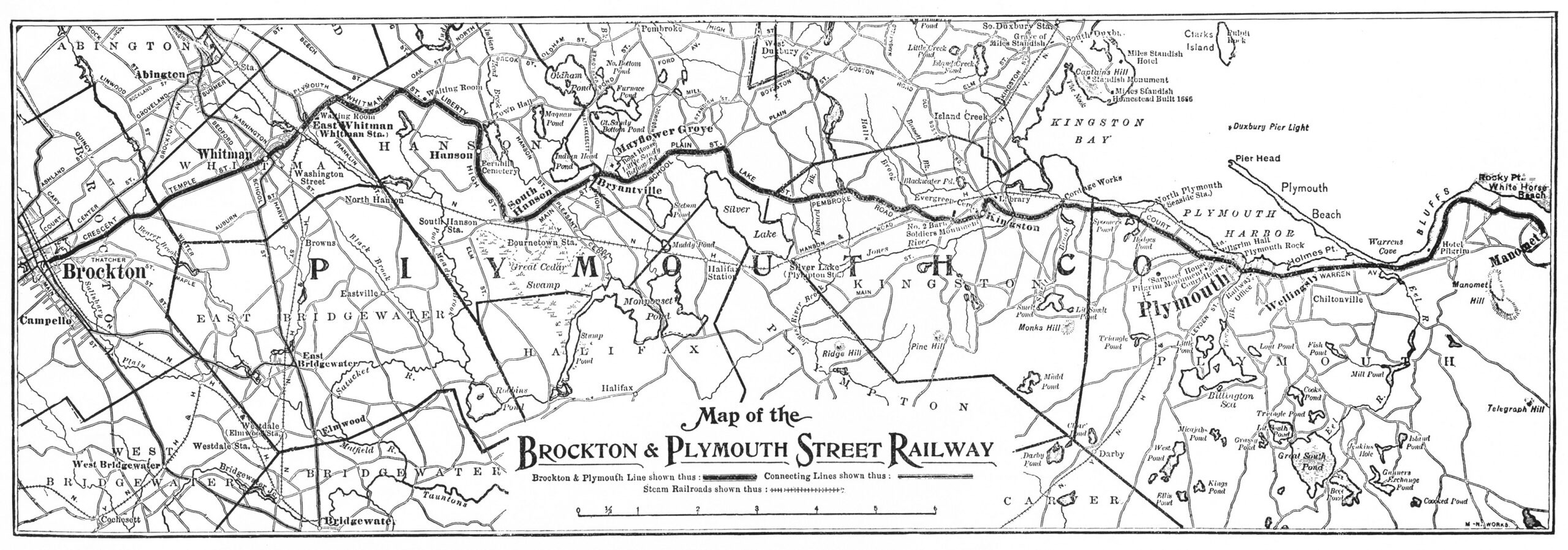
Popular weekend destinations included Nantasket Beach in Hull, Island Grove in Abington, and Mayflower Grove in Pembroke (a park built specifically by the Brockton & Plymouth Street Railway to fill their weekend cars). Local folklore even claims that the Brockton & Plymouth’s Sunday promotions coined the word “joyride,” though historians trace the word’s origins elsewhere.
The Turf War: The 1893 North Abington Riot
The integration of electric trolleys wasn’t entirely peaceful. Powerful steam railroad companies viewed the new streetcars as a direct threat to their passenger traffic, a rivalry that famously exploded in the North Abington Riot of August 1893.
When streetcar laborers from the Rockland & Abington Street Railway tried to lay a trolley crossing over the active tracks of the New York, New Haven & Hartford Railroad, the steam railroad fought back. They sent 300 men to tear up the trolley tracks, resulting in a full-blown riot. The battle featured hand-to-hand combat, pickaxes, and local firemen blasting the railroad workers with fire hoses. Sixteen people were injured before state police arrived with a court injunction ruling in favor of the trolley company. As a permanent peace offering to the town, the defeated railroad later constructed the beautiful H.H. Richardson-style North Abington Depot, which still stands today.
The Power Problem: Generating the Current
To keep the electric streetcars moving, early transit companies faced a massive infrastructure hurdle: securing a reliable source of electricity. At the turn of the 20th century, companies couldn’t simply plug into a robust, modern municipal power grid; they often had to become power companies themselves.
This necessity was perfectly illustrated by the legendary engineering duo Charles Stone and Edwin Webster. When the partners (owners of Stone & Webster Engineering) realized the need for a South Shore trolley service in 1889, they used their considerable resources to design and build the Plymouth & Kingston Street Railway from the ground up. Rather than attempting to buy electricity, Stone & Webster constructed a dedicated, coal-fired power plant directly next to Plymouth Rock. This strategic plant was essential for ensuring a “reliable current” to power the electric cars along what would eventually become an ambitious 24-mile route from Plymouth to Whitman.
However, this reliance on private power infrastructure eventually became a fatal economic issue for the trolleys. Operating an electric streetcar network meant bearing the astronomical capital costs of constructing and maintaining dedicated coal-fired power stations, along with miles of heavy copper overhead catenary wires.
As the years went on, the financial pressure of maintaining these independent power grids and copper lines escalated rapidly. Ultimately, this massive electrical infrastructure burden was a major reason transit operators eagerly pivoted to motorized buses. Buses offered a clear economic advantage because they completely eliminated the need to maintain expensive power plants and overhead wires.
The Fall: Rubber, Asphalt, and Economics
Despite their popularity, the streetcars’ decline was swift. While it is popular in some parts of the country to blame the demise of trolleys on a “General Motors streetcar conspiracy,” the South Shore network died from straightforward financial realities.
Following World War I, companies were hammered by inflation, rising labor costs, and bankruptcies. Simultaneously, the 1920s brought the rise of Henry Ford’s Model T, making personal car ownership affordable and sending public transit ridership plummeting.
To survive, transit companies initially transitioned to smaller, faster “Birney” trolley cars, but soon pivoted to motorized buses. Buses had a massive economic advantage: they didn’t require expensive iron tracks or copper wires, and their routes could be instantly adjusted to serve new neighborhoods. The Brockton & Plymouth ran its last electric car in 1928, the East Bridgewater lines closed in 1929, and the final Brockton-area streetcars ceased in 1937.
How the Streetcars Shaped the South Shore
Though the iron rails were torn up for scrap or paved over with asphalt long ago, the streetcars left an indelible imprint on the South Shore’s geography.
1. Streetcar Suburbs: The trolley corridors directly catalyzed the development of suburban neighborhoods. Developers built affordable, two-story Colonial Revival “Four-Square” homes and bungalows along the tracks to house commuting middle-class workers. The layout of these homes still traces the ghosts of the old rail lines today.
2. Civic Architecture: Municipal buildings from the era were built with transit in mind. The Whitman Town Hall, built in 1906–1907 directly on the Brockton & Plymouth line, features a grand Classical Revival porte-cochère (a vehicular drive-through canopy). While occasionally mislabeled as a purpose-built “trolley shelter,” this grand portico informally served as exactly that, shielding daily commuters from the rain and sun as they waited for their cars.
3. Modern Transit DNA: The modern transit network of the South Shore is a direct descendant of these early companies. The Brockton Area Transit Authority (BAT) and the MBTA Commuter Rail currently operate along the exact historical rights-of-way established by the 19th-century streetcar pioneers. Furthermore, the Plymouth & Brockton Street Railway Company survived the transition to rubber tires; today, it is simply known as P&B, a bus company still legally carrying its 130-year-old “Street Railway” name.
Sources include: The New York Times archives, p-b.com, South Shore Home and Lifestyle, Bill West blog, and AI deep research tools.


