

In the Massachusetts House, a legislator who chairs a committee and asks the state for money ends up with about two-thirds of what they asked for. A legislator who does not chair a committee gets about half.
That difference is worth roughly fifteen cents on every dollar requested. It has held in each of the last seven state budgets. And for most of the preceding decade it did not exist at all — through the 2010s chairs and everyone else did equally well, and in three of those years the chairs did worse.
Something changed around 2020, and what it produced is unusually specific. Seniority does not buy it: set the gavel aside, and a member first elected in 2011 does no better than one elected last year. Rank does not buy it either — vice chairs, who hold the title and in most cases the stipend that comes with it, do no better than backbenchers, and in the last two budgets they did worse. A second-term member with a gavel outperforms a twenty-year veteran without one.
None of this is decided by vote. Last spring members filed 1,651 amendments to the House budget. The House held a recorded vote on nine of them, and defeated all nine. Another 1,571 were sorted, in private, into seven bundles, each brought to the floor as a single take-it-or-leave-it package. No member ever cast a recorded vote on whether Hanson’s fire department should get $25,000, or whether Swansea’s sewer system should get $50,000. Someone decided. The record does not say who.
The finding
The analysis covers every House budget amendment filed over sixteen years — roughly 20,000 amendments across FY2012 to FY2027 — and every enacted state budget over the same period.
The gap is recent. From FY2012 through FY2019, chairs and non-chairs succeeded at statistically similar rates; the average difference across those eight years was zero, and in three of those years chairs did worse. Beginning with the FY2020 budget, and sharply from FY2021 onward, chairs pulled away.
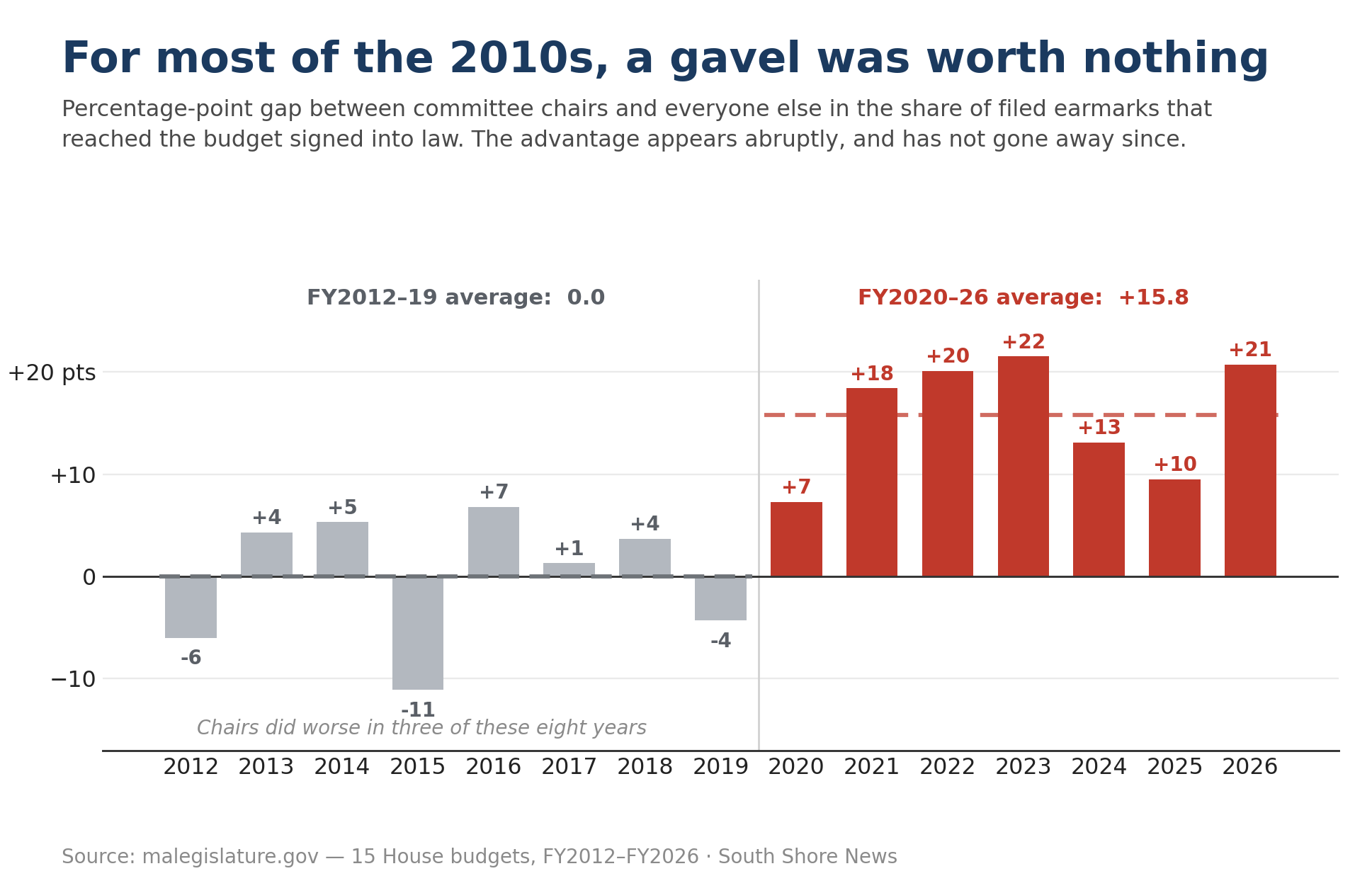
On counts, across the last seven budgets the average gap is 15.8 percentage points, positive every year without exception.
On dollars, measured as the share of requested money a member actually ends up with, the gap averages about 15 percentage points and is positive in all seven years from FY2021 to FY2027. Across FY2021 to FY2026, chairs ended up with 66.1 percent of what they asked the state for. Everyone else got 47.0 percent — a gap of 19.2 points, which comes down to 15.2 once shared credit is accounted for, as described below.
The measure is deliberately simple. For each earmark, compare the “not less than $X” a member asked for against the “not less than $X” in the General Appropriations Act the Governor signed. Multiply the odds of getting in by the share funded once in. No intermediate stage, no interpretation.
One judgement call has to be disclosed, because it moves the number. Roughly half of all amendments carry co-sponsors. If credit goes only to the member who filed the amendment, the gap averages 18.5 points. If every co-sponsor is credited equally with the filer, it falls to 8.0. Splitting the difference — the filer gets full credit, co-sponsors share the remainder — gives 15.2.
The premium is positive in all seven years under all three rules. The figure used throughout this piece is the middle one: 15.2 points, with a 95 percent confidence interval from 10.7 to 19.9. Non-chairs co-sponsor considerably more than chairs do, which is why the choice matters.
Where the advantage actually comes from
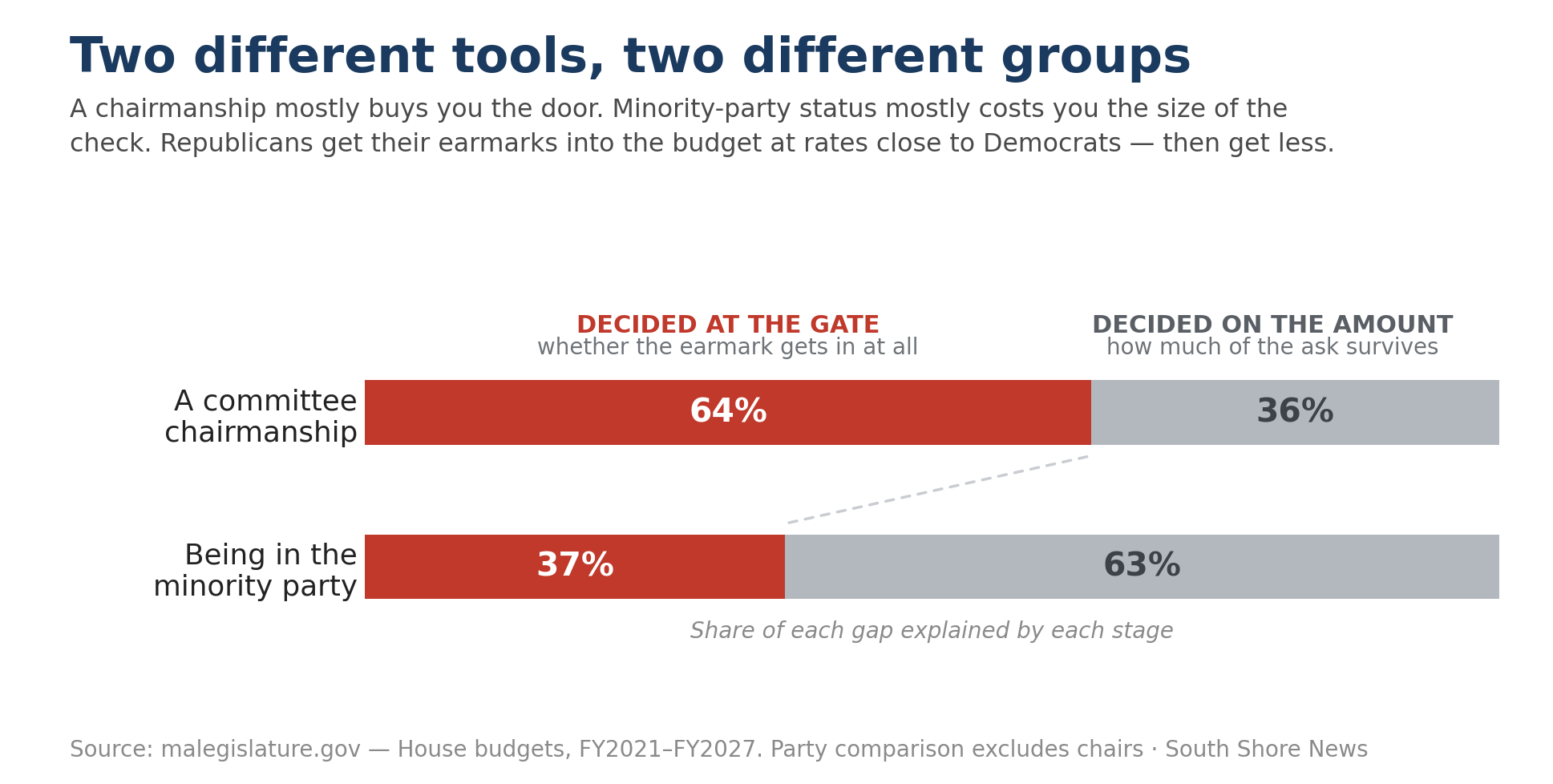
The gap decomposes cleanly, and the answer is not the obvious one. Roughly 64 percent of it comes from simply getting the earmark into the budget at all, and 36 percent from being funded closer to the full ask.
Two-thirds of a chairmanship’s value is the gate, not the amount. Once a project is in the budget, a chair’s earmark is funded at 81.6% of ask against 72.9% for everyone else — a real advantage, but a much smaller one than the difference in whether it appears at all.
The gavel gets you through the door. It buys you a somewhat larger check once you are inside.
(Decomposition computed on filer-only credit, FY2021–26.)
How the sorting works
Massachusetts House budget debate does not look like debate. Leadership sorts the filed amendments by subject into a handful of “consolidated amendments,” lettered A through G, each drafted behind closed doors and brought to the floor as one vote.
The whole FY2026 debate produced nineteen recorded votes across three days. Nine were on individual amendments, every one of them defeated by margins of roughly 25 to 130. Seven were on the bundles themselves, which passed 151–157 votes to nothing or nearly nothing. The remaining three were procedural. Fifty-four amendments were withdrawn before they reached any of it.
Your earmark either appears in the bundle, appears at a smaller number, or quietly does not appear. Nothing is voted down. Nothing is recorded.
Representative Justin Thurber, a Somerset Republican, filed an amendment last spring seeking $50,000 to repair the sewer system in Swansea. Consolidated Amendment E contains it at $10,000, inserted into a line item called 1599-0026. The budget the Governor signed contains no Swansea sewer provision at all.
Swansea appears three times in the final law — $25,000 for an intersection redesign, $75,000 for recreational upgrades at Medeiros Farm, and the school aid table. Neither funded item is among Thurber’s five amendments. His separate request for $210,000 for Swansea’s culverts and bridges was assigned to Bundle E and its text never appears in it.
Filed at fifty thousand. Cut to ten behind closed doors. Gone from the law entirely. Every step of that sequence is in a public document, and at no point did anyone vote.
Partial funding is routine. Of the 709 FY2026 earmarks that reached the enacted budget with a traceable figure, 279 — nearly two in five — were funded below what was asked. Another 395 got exactly the amount requested, and 35 got more.
What it isn’t
Seven alternative explanations were tested. All fail.
It isn’t seniority. Chairs are more senior, and this is the objection that most needs answering. Tenure was rebuilt from each member’s first appearance across all sixteen budgets, and the comparison run within tenure bands. Among members who have served since 2016 or earlier, the chair advantage is +17.2 points, positive in all seven years (95% confidence interval 9.8 to 24.1), with cells of 29 to 36 chairs.
Seniority on its own, among members without a gavel, is worth +0.3 points, with a confidence interval running from −7.3 to +7.8 — statistically indistinguishable from nothing. A second-term member with a chairmanship outperforms a twenty-year veteran without one.
And it isn’t rank, either — it is the gavel specifically. Vice chairs, who hold a title and in most cases a stipend, do essentially no better than members with no position at all: +2.4 points, confidence interval −4.2 to +8.9. In the two most recent budgets they did worse. Chairs outscore vice chairs by 14.1 points, positive in all seven years.
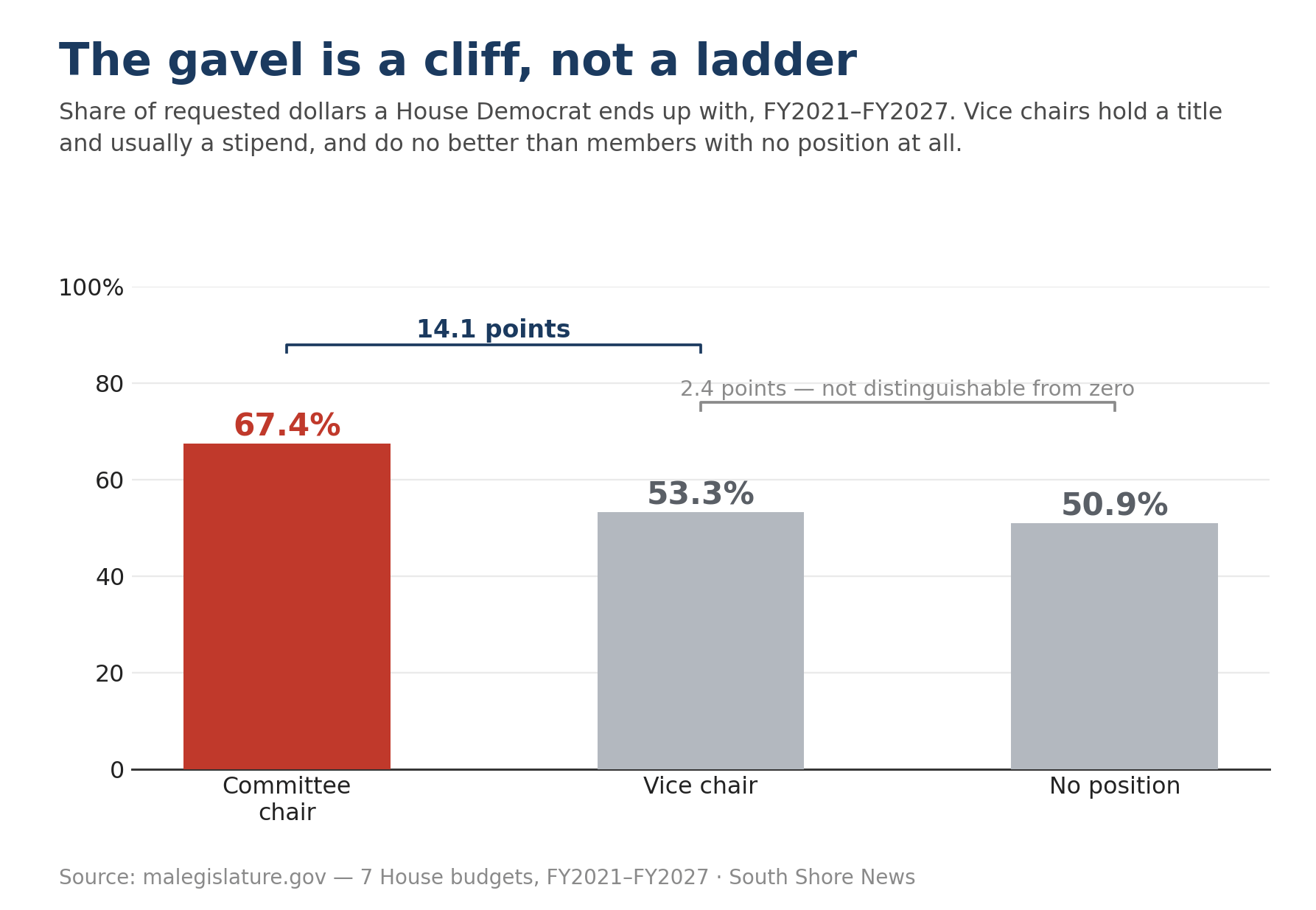
The House does not reward seniority, and it does not reward rank. It rewards one thing.
It isn’t party, in the sense that matters here. The chair gap holds within the Democratic caucus alone. (Party matters enormously in its own right — see below — but it does not explain the gavel.)
It isn’t one stage of the process. It appears in the private bundle and in the enacted law, two independent measurements.
It isn’t the accounts they choose. Within the 40 line items where both chairs and non-chairs filed requests, chairs succeeded at 87.5 percent against 64.3 percent — a wider gap than the overall figure.
It isn’t that chairs ask for less. Per member, chairs asked for more in FY2026 — $1.64 million each against $1.32 million — and still did better. In aggregate non-chairs asked for more simply because there are more of them.
It isn’t a measurement artifact. An audit of the matching method found one genuine defect affecting 1.7 percent of cases, distributed evenly across chairs and non-chairs, incapable of moving the result.
The minority is punished differently
Party matters nearly as much as the gavel, and it works by an entirely different mechanism.
Comparing only members without a chairmanship, so the chair effect is held constant, a rank-and-file Democrat ends up with about half of the money they asked for. A Republican gets a little over a third. The gap averages roughly 13 points and is positive in all seven years — and unlike the chair premium it is barely affected by how shared credit is handled, holding at 12 points when co-sponsors are counted.
The confidence interval is wide — 3.9 to 23.4 points — because there are only about 38 Republicans to measure. The direction is certain; the precise size is not.
The structural fact underneath it: no Republican held a committee chairmanship in any of the four legislative sessions examined. All 41 chairs in the current House are Democrats. A Republican is not disadvantaged within the system that produces the chair premium; they are outside it.
But the interesting part is how the penalty is applied. The chair premium, as described above, is 64 percent about inclusion and 36 percent about the amount. The party penalty is almost exactly the reverse: 37 percent inclusion, 63 percent amount.
The House rations the gavel at the gate and party at the amount. A Republican’s earmark is roughly as likely to appear in the budget as a Democrat’s — in FY2024 it was more likely, 69.9 percent against 66.2. What happens is that the number shrinks. That year Republicans were funded at 55.7 percent of what they asked; Democrats at 74.8 percent.
Two different tools, applied to two different groups, in the same document.