

WEYMOUTH - August 13, 2026 - In the only face-to-face meeting scheduled in the 8th Congressional District Democratic primary, U.S. Rep. Stephen Lynch and challenger Patrick Roath spent much of a 65-minute forum in Weymouth attacking the sources of each other’s money. Roath cast the 25-year incumbent as a product of corporate PAC contributions and “the politics of the past.” Lynch answered by attacking Roath’s decade at the law firm Ropes & Gray, telling the audience the firm “bust[s] unions for a living” and advises the private equity companies he blames for closing area hospitals.
The Full Story
MA-08 voters filled the Chapman Middle School auditorium in Weymouth Thursday evening for a forum hosted by the League of Women Voters of Hingham along with the leagues of Boston, Norwood, Sharon-Stoughton, Westwood-Walpole-Dedham and the state league. Courtney Henderson, LWVMA co-president and a Fall River resident, moderated. Under league rules, the moderator may not live in the district, and the questions were drafted jointly by the participating leagues rather than taken from the floor.
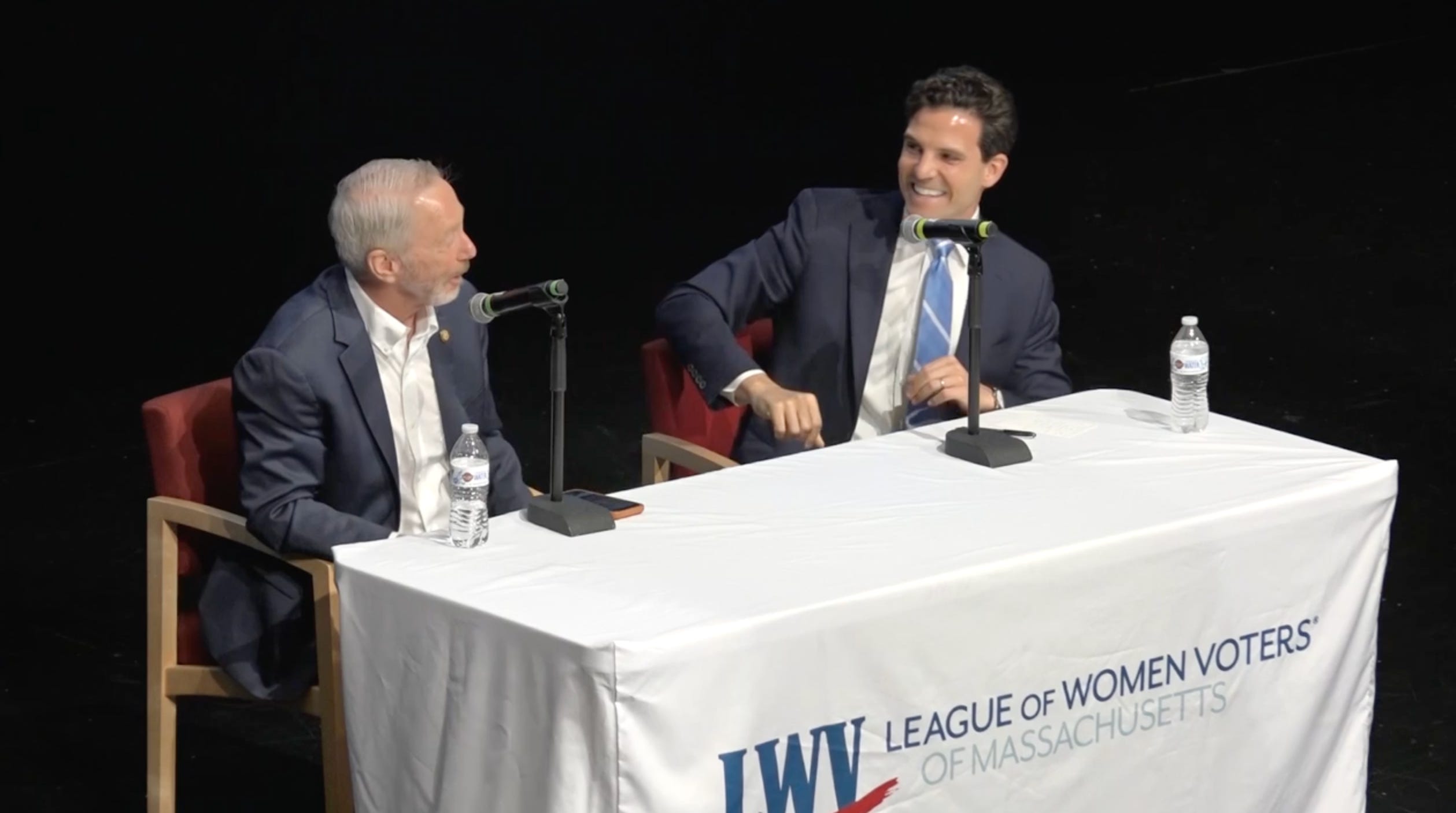
The two men agreed on the stakes and on very little else. Both opened by describing the second Trump administration as a threat to constitutional government. Both said housing costs are a defining problem in the district. From there the forum turned into a sustained argument about who each candidate has worked for.
Roath, a 39-year-old attorney and former aide to Gov. Deval Patrick, set the frame in his opening statement, saying the moment requires “a new kind of leadership” and that his opponent “has taken millions of dollars in corporate PAC money.” He returned to the theme in nearly every answer, pairing it with two votes: Lynch’s 2010 vote against the Affordable Care Act and his vote last year for the Laken Riley Act.
“One member from the Massachusetts congressional delegation voted for that bill last year,” Roath said of the immigration measure. “One member, Congressman Stephen Lynch.”
Lynch pushed back directly on the money question. Asked to name his priorities for the next term, he began with campaign finance. “Let me be clear,” he said. “The PACs that I have accepted money from are the iron workers. The iron workers donate — when I was an iron worker, they still do it today — nine cents, nine cents an hour, $3.60 a week. That’s their PAC.” He then accused Roath of benefiting from outside money himself, pointing to mail pieces district voters have received. “My opponent has had four mailings, you’ve probably got them all, and they’re all from PACs that he’s working with, so that’s phony baloney.”
Lynch spent much of that answer on what he called the larger danger — the scale of corporate spending on Congress. He said cryptocurrency interests spent $237 million influencing the recent Clarity Act vote and that Democrats broke ranks as a result, and warned that artificial intelligence companies will “dwarf” that. Lynch is the ranking Democrat on the House panel handling AI oversight.
Roath, who has pledged not to accept corporate PAC money, tied the issue to his record chairing Common Cause Massachusetts, where he said his advocacy helped win automatic voter registration and mail-in voting in the state. He called for public financing of elections and for overturning Citizens United. Mid-answer he began to say Lynch had taken “hundreds of millions of dollars,” then stopped himself. “Excuse me, that’s not right, that’s way too much,” he said. “That’s like Trump.”
The Sharpest Exchange
The forum’s most heated moment came on a question about protecting Medicare, Medicaid and Social Security. Roath answered by describing the Republican reconciliation bill as an oncoming threat to community health centers, endorsing Medicare for All and proposing to raise the Social Security payroll tax cap, which currently tops out near $185,000.
Lynch opened his response with: “That was rich.” He then turned to Roath’s employment history.
“There’s a quote from Don Quixote,” Lynch said. “Show me your company and I’ll tell you what you are. My opponent has been working for Ropes and Gray for the last 10 years. Ropes and Gray is famous for two things. One, they bust unions for a living. Number two, they push for-profit health care.”
Lynch linked that to the collapse of Steward Health Care, listing Carney, Norwood, Nashoba Valley and Quincy among hospitals the region has lost, and said the area is down more than a thousand beds. “That’s why if you were hurt today and you had to go to the hospital, they have a practice they call now, it’s called boarding,” he said. “That’s what we’re dealing with right now. And that’s shameful.”
Roath rejected the connection outright in his next turn. “Instead of providing any answer to that question, my opponent started attacking me for something that was false,” he said. “I just had nothing to do with Steward, never worked on it, no idea anything about it.” He defended his resume — clerking at the Justice Department, a Fulbright fellowship at the State Department, campaign and White House work, Common Cause — and said none of it involved for-profit health care. He added that he would co-sponsor Sen. Elizabeth Warren’s bill targeting private equity in hospital ownership “on day one,” and noted Lynch has not co-sponsored it.
Health Care, Immigration and Education
On health care affordability, Lynch called for eliminating for-profit ownership of hospitals, health centers and nursing homes, arguing private equity operates on “a dual mission” in which investor returns come first. He then said the Affordable Care Act itself needs to be reopened, citing an antitrust exemption for insurers and a tax on union health plans as his original objections, and said the answer “might involve Medicare for all.”
Roath called that framing dangerous. “If you want to repeal the ACA, just go with the Republicans,” he said, arguing the law is why insurers cannot discriminate on pre-existing conditions and why young adults stay on parents’ plans. He proposed breaking up pharmacy benefit managers as an interim step toward universal coverage.
On immigration, both called for comprehensive reform and a pathway to citizenship. Roath said ICE “has outlived its purpose” and “should be dismantled,” and that agents deploying masked into American streets “should be prosecuted and jailed.” Lynch said he is an original co-sponsor of the DREAM Act, said he has “repeatedly voted to defund ICE,” and described legislation to force agents to remove masks, wear name plates and body cameras and return to the border. He said Trump has used immigration “as a lever to actually turn us against each other,” adding that when the president says immigrants are poisoning the nation’s blood, “your Nazi alarm should go off.”
On elections, Lynch described a bill protecting mail-in voting and said he belongs to a group of 30 House Democrats that has filed more than 700 lawsuits against the administration since January 2025. Roath said Lynch had omitted the central federal statute and called passing the John Lewis Voting Rights Act “the first order of business.”
Education produced the evening’s warmest agreement, with both men crediting individual teachers for their trajectories — Lynch recalling a handful of teachers between kindergarten and eighth grade in South Boston, Roath describing himself as a product of public schools. Both said the federal government has never met its 40 percent commitment for special education funding. Roath noted endorsements from the Boston Teachers Union, AFT Massachusetts and the Massachusetts Teachers Association, saying district educators “are looking for a champion. They don’t have one right now.”
On guns, Lynch spoke about his cousin and his nephew-in-law, both shot and killed, and described occupying the House chamber with the late Rep. John Lewis over Republican refusal to take up gun legislation. Roath called for licensing firearms the way cars are licensed and said he disagrees with the Supreme Court’s reading of the Second Amendment.
Closing Arguments
Roath closed on generational stakes, describing an eight-month-old daughter asleep in Jamaica Plain and asking what country she inherits. “We can’t keep sending the same people down,” he said earlier in the night. His campaign has knocked “tens of thousands of doors,” he said, and he left his job to run.
Lynch closed on experience and on his oversight record, noting he investigated Trump twice on the Oversight Committee and that both inquiries ended in impeachments. He said the White House has labeled him an “ICE agitator” after he demanded access to ICE facilities at Plymouth County and Logan Airport — “which is like a badge of honor for me.”
“There’s no way in hell I could have went onto Congress and represent close to 800,000 people without all that experience and the lessons I learned,” he said, reflecting on the state legislative offices he held prior to running for Congress, a contrast with first time candidate Roath.
Why It Matters
The 8th District covers parts of Boston, the South Shore and Brockton, a region that has not sent anyone but Stephen Lynch to Washington since 2001. In a district this reliably Democratic, the September 1 primary is effectively the general election — whoever wins it is overwhelmingly likely to be the district’s next member of Congress. Republican Robert Burke is running again, after getting about 30% of the vote against Lynch in 2024 and 2022. Burke was also in attendance at the forum watching from the audience and at one point asked to stop recording by the League of Women Voters.
The forum also mattered for a reason that had nothing to do with policy. Lynch has drawn a Democratic primary challenger in five election cycles since 2001, and has appeared alongside one in three of them: a brief WBZ-TV segment with Mac D’Alessandro in 2010, a virtual League of Women Voters forum with Robbie Goldstein in August 2020, and Wednesday night. He held no joint events at all with his 2018 challengers. Roath had called in June for debates in Boston, Quincy and Brockton; none were scheduled. For most voters in this district, Wednesday was the only chance to see the two candidates answer the same questions in the same room.
Lynch has not held an in-person town hall of his own since 2019, Axios Boston reported in June; his two most recent, in March 2025 and May 2026, were virtual, with questions submitted in advance through a web form. A Lynch spokeswoman told Axios the campaign has “found that holding the Town Halls virtually is the most accessible option.” Wednesday’s questions were also drafted in advance, by the participating leagues, and none were taken from the floor.
Questions and Timestamps
Welcome and rules: Kate Boland, League of Women Voters of Hingham; moderator Courtney Henderson. (0:27–5:19)
Opening statements: Lynch, then Roath. (5:20–9:28)
Three priorities for the next term: Roath — child care, political reform, climate resilience. Lynch — money in politics, housing, artificial intelligence. (9:35–15:48)
Federal role in regulating elections: Lynch — protecting mail-in voting, litigation against the administration. Roath — passing the John Lewis Voting Rights Act, public financing. (15:51–21:32)
Immigration reform: Roath — pathway to citizenship, dismantling ICE, Laken Riley Act criticism. Lynch — DREAM Act, ICE oversight and defunding votes. (21:33–27:30)
Rising costs of housing, energy, food and child care: Lynch — tariffs and federal program cuts. Roath — supply-side housing plan, child care pipeline. (27:43–33:57)
Gun violence and the Second Amendment: Roath — licensing, closing the gun show loophole. Lynch — family losses, no-fly list and waiting-period bills. (34:06–39:16)
Federal role in education: Lynch — teacher pay, special education, the Pappas School in Canton. Roath — IDEA funding, union endorsements, rebuilding the Education Department. (39:24–45:07)
Protecting Medicare, Medicaid and Social Security: Roath — payroll tax cap, Medicare for All. Lynch — Ropes & Gray and private equity exchange. (45:15–51:33)
Health care affordability and access: Lynch — ending for-profit ownership, reopening the ACA. Roath — defending the ACA, pharmacy benefit managers. (51:41–58:06)
Closing statements: Roath, then Lynch. (58:08–1:04:25)
Fact Check
Lynch: “The PACs that I have accepted money from are the iron workers.” Federal Election Commission filings do not support this. Through June 30, 2026, Lynch’s campaign reported $308,600 in contributions from other political committees — 37.8 percent of his $817,344 in total receipts. By committee name, roughly $161,500 came from labor unions and roughly $141,700 from corporate and trade association PACs, including BlackRock, State Street, Fidelity, TD Bank, Prudential, MassMutual, John Hancock, Liberty Mutual, Ernst & Young, RTX and AT&T. Banking, insurance, investment and real estate committees alone accounted for about $77,500. The single largest PAC contribution was $10,000 from the National Association of Insurance and Financial Advisors. Lynch sits on the House Financial Services Committee.
Roath: “This campaign is not taking corporate PAC money.” Supported. Roath’s committee reported $11,000 from other political committees — $5,000 from the American Federation of Teachers, $5,000 from the PAC Leaders We Deserve, and two $500 transfers from candidate committees. None are corporate. Individual donors supplied 93.9 percent of his $1.11 million in receipts, and his unitemized small-dollar share, 13.5 percent, is five times Lynch’s 2.7 percent.
Lynch: Roath’s mailings “are all from PACs that he’s working with.” Partly supported. One committee, David Hogg’s Leaders We Deserve, accounts for every dollar of outside spending in this race — $201,697 through August 3, split between $98,920 in mail supporting Roath and $102,777 in mail opposing Lynch. No outside group has spent supporting Lynch or opposing Roath. Independent expenditures are legally required to be uncoordinated with a campaign, so supporting would be a more accurate characterization than “working with.” Leaders We Deserve is also a $5,000 direct donor to Roath’s campaign and has endorsed him.
Roath: Lynch is “the only Democrat left in Congress who voted against the Affordable Care Act.” Accurate, and Lynch did not dispute it. He defended the vote, citing the insurance industry antitrust exemption and a tax on union health plans in the Senate version.
Roath: Lynch "has taken millions of dollars in corporate PAC money." Supported. Federal Election Commission records for Lynch's campaign committee show $4,870,193 in contributions from political action committees across 13 election cycles — from his 2001 special election through June 30, 2026 — amounting to 34.8 percent of the $13.98 million he has raised over his career. Roughly $2.4 million of that came from corporate and trade association committees, spread across more than 440 separate PACs. Finance, insurance and real estate committees alone account for about $974,000; he has served on the House Financial Services Committee throughout his tenure. Corporate money exceeded union money in ten of the twelve cycles for which the FEC provides itemized records.
What’s Next
Voter registration closes Saturday, August 22. Applications to vote by mail are due Tuesday, August 25. Early voting runs August 22 through August 28. The Democratic primary is Tuesday, September 1, which is also the deadline for mail-in ballots to be received. Voters can check registration status at voteinma.com or through their city or town clerk.
I would vote for Roath if I could. Lynch will never support universal health care because it would impact collective bargaining. He’s a conservator democrat.