


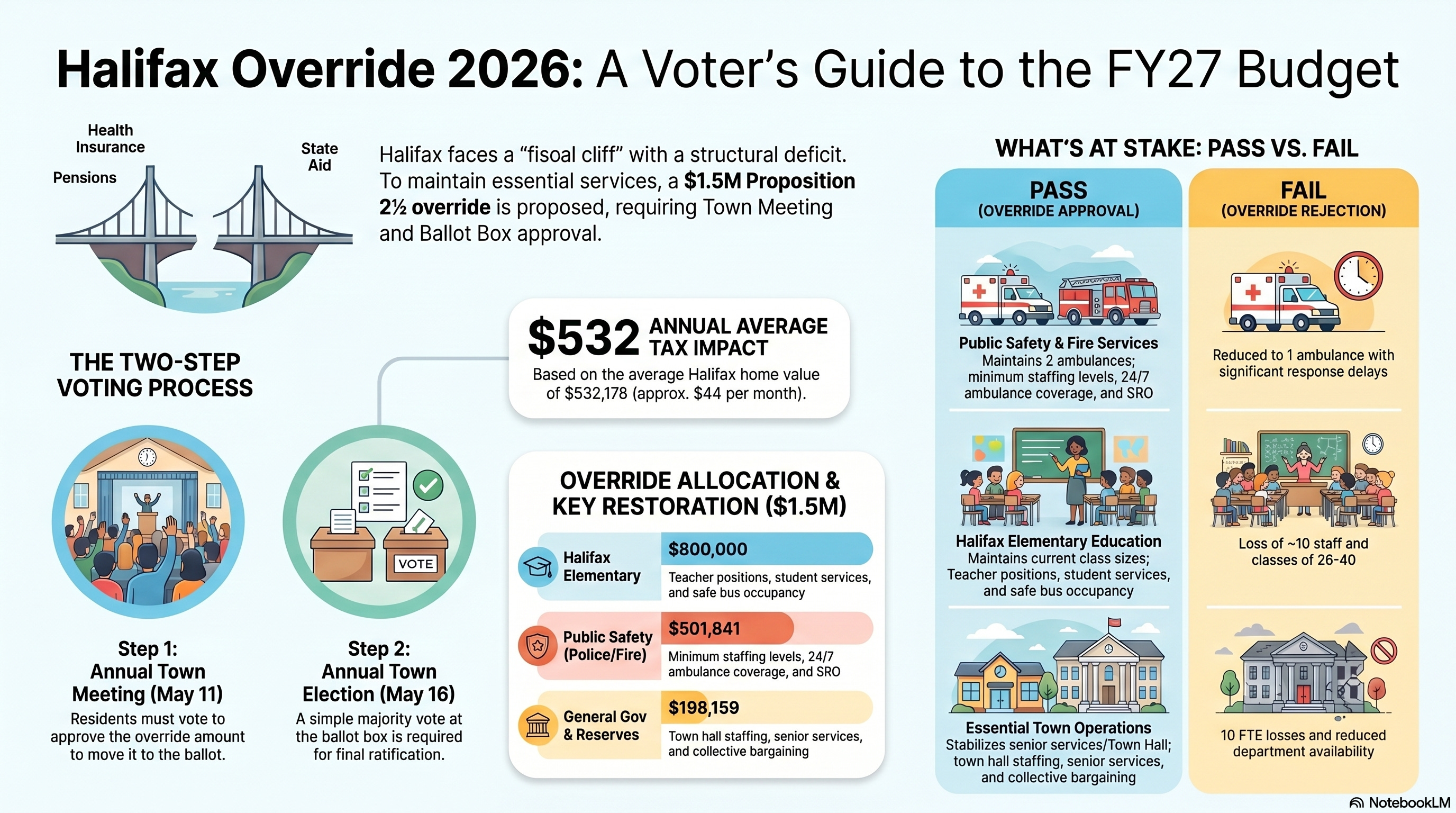
Town of Halifax is asking residents if they’ll approve an operational tax override for the first time in two decades. Facing what Town Administrator Steven Solbo calls a “fiscal cliff,” the town government must close a significant structural deficit for Fiscal Year 2027.
If approved, the $1.5 million Proposition 2½ override will maintain current town services. If it fails, voters will see sweeping cuts across public safety, schools, and essential community services.
Here is your comprehensive guide to understanding the numbers, the voting process, and the real-world impacts of the upcoming override decision.
How Did We Get Here?
Proposition 2½ is a Massachusetts law that limits a municipality’s ability to raise property taxes by more than 2.5% per year without voter approval. Since Halifax’s last operational override in 2005, inflation has increased by roughly 66.5%, while the town’s tax levy has only grown by about 50%.
Simply put, revenues have not kept pace with rising fixed costs. In the past year alone, the town has been hit with major unavoidable expense hikes:
Health Insurance: Up 14.2% (an increase of about $190,000).
Pension Assessments: Up 7.1% (a $160,000 increase).
Liability Insurance: Up nearly 28% (a $30,000 increase).
Silver Lake Regional Assessment: Up 6%.
Simultaneously, outside funding has dried up. Chapter 70 funding for education hasn’t kept up with modern education costs and state mandates. Other State Aid is generally flat. Furthermore, the town’s non-compliance with the state’s MBTA Communities Zoning Law has locked Halifax out of roughly $400,000 in state grant funding that could have otherwise offset costs for energy, the schools, and the fire department. Because the town relies heavily on residential property taxes—with commercial properties making up only an estimated 5% to 7% of the tax base—the burden of these shortfalls falls almost entirely on homeowners.
The Mechanics of the Vote
Passing an override in Massachusetts is a two-step process.
Town Meeting (Monday, May 11, 2026): Voters on the floor will debate the town budget (Article 3A) and the override funding allocation (Article 3B). The override must pass at Town Meeting to remain viable.
Annual Town Election (Saturday, May 16, 2026): The override must be affirmed by voters at the ballot box.
If it passes at Town Meeting but fails at the ballot box, the override is defeated, and the baseline budget with severe cuts goes into effect for the next 365 days starting July 1.
The Financial Impact on Taxpayers
The town has provided exact figures for what this override will cost the average resident.
The Average Home Value in Halifax is assessed at $532,178.
The Override Cost for that average home will be $532 per year (or approximately $44 per month).
This cost is in addition to the standard 2.5% annual tax increase.
What Happens if the Override Fails? (The Cuts)
If voters reject the override, the town will operate under the baseline budget (Article 3A), which includes nearly $1.5 million in targeted departmental cuts.
Public Safety (Police & Fire): The Halifax Police and Fire Departments will absorb $290,021 in combined cuts.
Fire & EMS: The department will be cut by $140,000, forcing them to operate with only two members per shift and dropping from two active ambulances to one. This means if the single ambulance is out on a call, the town will have no coverage and must wait for mutual aid from neighboring towns—which are also facing staffing shortages. Furthermore, reduced fire staffing could hurt the town’s ISO rating, which directly dictates homeowners insurance premiums. A drop in the ISO rating could increase residents’ home insurance premiums by 25% to 50%, potentially costing homeowners more than the override itself.
Police: The department will be cut by $150,021. The department will lose its dedicated School Resource Officer (SRO) at Halifax Elementary, cut the court prosecutor and matron positions, reduce clerical window hours, and scale back patrol staffing. The town will also cut its independent Animal Control Officer contract and attempt to regionalize the service with Plympton to respond only to major public safety incidents.
Halifax Elementary School: The school faces an $800,000 budget cut, which threatens its ability to meet the state’s Net School Spending minimums.
This reduction will force the elimination of approximately 10 full-time equivalent (FTE) positions, including math, literacy, and special educators.
Class sizes will jump to between 28 and 40 students per room, and vital student support services will be reduced.
Families may also face new out-of-pocket fees for full-day kindergarten and school busing to help close the gap.
Council on Aging (COA) & Town Services:
Council on Aging: The COA faces a devastating $155,886 reduction. The director’s position will be reduced to part-time, two full-time outreach and administrative roles will be eliminated, and the senior center will be forced to cut its hours down to just three days a week.
Town Hall: Administrative offices will be trimmed to the bone. The Assistant Town Accountant will be cut to part-time, and the Assistant Treasurer and Assistant Collector roles will be merged into a single position. The building maintenance department will permanently eliminate a janitorial role, meaning fewer cleanings for town buildings.
(Note: The Halifax Public Library was mostly spared from direct personnel cuts because any further reduction would cost the library its state accreditation, blocking Halifax residents from borrowing books from other Massachusetts libraries and eliminating the library’s state grant funding.)
What Happens if the Override Passes? (The Restoration)
If the $1.5 million override passes (Article 3B), the town will allocate those funds directly back into the community to restore level services.
Public Safety: $290,021 will be immediately allocated to restore the Police and Fire departments, keeping two ambulances running, saving the School Resource Officer, and maintaining safe shift minimums.
Schools: $800,000 will be restored to Halifax Elementary, preventing mass layoffs, keeping class sizes manageable, and maintaining current curriculum and support programs.
COA and Town Hall: $86,165 will be returned to the Council on Aging to maintain the director’s full-time salary and fund part-time support staff so the building can remain open to seniors. Critical accounting and treasury roles will be restored to ensure the town meets its payroll and legal compliance duties.
Union Contracts: The remaining roughly $199,000 will be placed in a reserve fund. The town is actively entering collective bargaining with five of its six municipal unions (including police, fire, and highway), as well as renegotiating expiring contracts for the Fire Chief and Deputy Police Chief. This reserve will allow the town to legally secure its workforce for the next three years.
The Bottom Line The decision rests entirely with the voters. As Halifax officials have repeatedly stated, the override does not add new, lavish programs—it simply maintains the town exactly as it operates today. On May 11 and May 16, voters will decide whether the preservation of those services is worth an extra $44 a month.
Sources include: The Town of Halifax, South Shore News, and Area58


