


The Menu Override: Abington’s Democratic Strategy for Fiscal Sustainability
On Saturday, May 16, 2026, Abington voters will head to the polls to face one of the most consequential financial decisions in the town’s recent history: a $3.625 million Proposition 2½ override. Unlike traditional override requests that present a single, all-or-nothing dollar amount, Abington’s Select Board has opted for a “menu” approach, carving the request into seven distinct ballot questions representing different town departments.
As the town navigates this critical juncture, voters are asking: Why is this massive funding infusion necessary? Why are we using a menu format? And based on the history of Massachusetts municipalities, does this approach actually work?
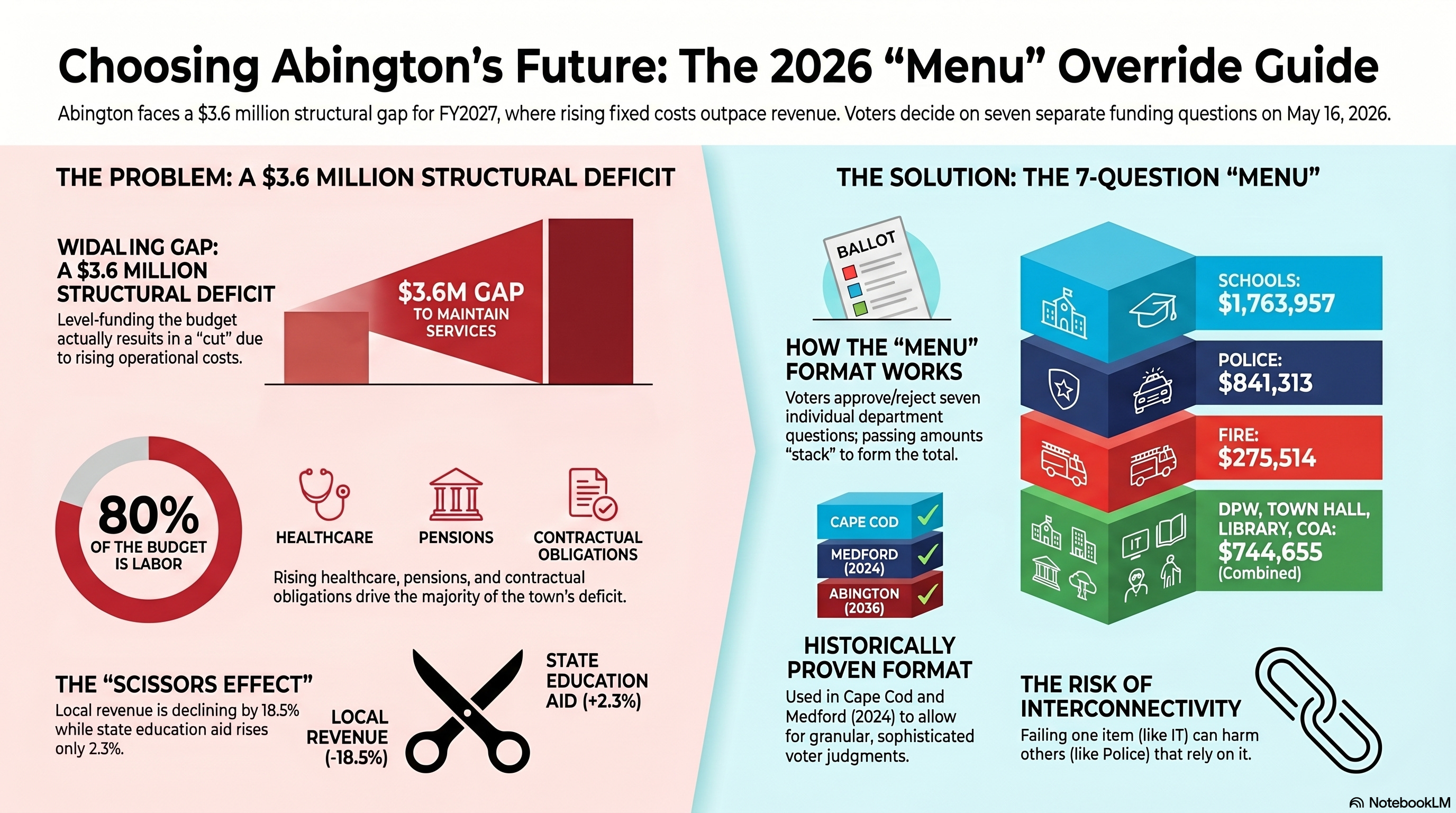
The Fiscal Reality: Why an Override is Necessary
Town Manager Michael Maresco has plainly described Abington’s situation not as a mismanagement of funds, but as a severe “revenue problem”. The town is facing a structural deficit driven by fixed costs—often referred to as “budget busters”—that are rising much faster than the town’s allowable revenue.
Under Massachusetts’ Proposition 2½, the town’s property tax levy can only grow by 2.5% annually, plus a small amount from new growth. Meanwhile, Abington is grappling with an anticipated 8% to 10% increase in employee healthcare premiums, soaring utility and fuel costs, and the burdens of unfunded state mandates, particularly in special education. Furthermore, the town is on an accelerated schedule to fully fund its Plymouth County pension obligations by 2032.
This pressure is compounded by stagnant state aid—Chapter 70 education funds are expected to rise by only 2.3%, and unrestricted local aid by a net 1.1%. Abington’s commercial tax base is also unusually thin, making up just 7.68% of the town’s assessed value, leaving residential property owners to shoulder the vast majority of the tax burden.
Because of this revenue gap, a “level-funded” budget for Fiscal Year 2027—meaning departments receive the exact same dollar amount they did in FY26—actually acts as a functional cut to services. To maintain a “level-service” budget (keeping the town operating exactly as it does today), an infusion of $3,625,439 in new, permanent tax revenue is required.
What is at Stake? The Seven-Course Menu
If the override questions fail, departments will be forced to absorb devastating cuts starting July 1, 2026. The seven questions on the May 16 ballot break down the requests and the stakes as follows:
Schools ($1,763,957): The largest question on the ballot. Superintendent Dr. Felicia Moschella has warned that a failure here means the elimination of 28.1 full-time equivalent positions. This translates to increased class sizes, the elimination of reading and math interventionists, cuts to mental health supports, and the loss of electives that will force many middle and high school students into mandatory “academic labs” (study halls).
Police ($841,313): Chief John Bonney has stated that failure would require laying off six patrol officers and four civilian administrative staff, reducing the patrol force back to bare minimums. Consequently, all School Resource Officers (SROs) would be pulled from Abington schools.
Fire ($275,514): Driven largely by the need for overtime to cover shift vacancies, equipment maintenance, and training. Chief Jack Glynn warned that without these funds, the department might have to decommission the town’s second ambulance, relying instead on mutual aid from neighboring towns—delaying critical medical response times and losing ambulance revenue.
Public Works ($261,094): DPW Director John Stone noted that losing two laborers would strain an already lean crew, impacting storm water drainage projects, field striping for youth sports, road maintenance, and winter snow and ice removal.
Town Hall ($463,130): Encompassing the Town Manager, Clerk, Assessors, IT, and Health offices, a lack of funding could result in mid-day closures of Town Hall to allow staff to process mandatory paperwork.
Library ($15,964): Without this funding, the Abington Public Library would fail to meet state requirements for municipal appropriation, resulting in the loss of state aid certification and the critical ability to participate in interlibrary loan networks.
Council on Aging ($6,468): Though the smallest amount on the menu, these funds are vital for maintaining senior transportation, Meals on Wheels, and matching grants that support the town’s most vulnerable elderly residents.
Why a “Menu” Override?
Municipalities have a few ways to structure an override. They can use a “single-question” format (a monolithic request for one total dollar amount) or a “tiered/pyramid” format (alternative funding levels where only the highest passing amount takes effect).
Abington chose the menu approach. This presents independent questions for different departments. Voters can approve one, some, all, or none of the questions. The passed amounts add together; failing questions simply drop away. If all seven questions pass, the average Abington homeowner (with a home valued at roughly $588,990) would see an estimated permanent tax increase of approximately $425 to $435 per year.
Officials and finance committees favor the menu format for a few strategic reasons:
Direct Democracy & Voter Choice: It empowers residents to participate in “pick-and-choose” budgeting, prioritizing the services they are willing to pay for rather than accepting a take-it-or-leave-it bundle.
Strategic Risk-Spreading: In a single-question override, if the measure fails, every department suffers the cuts. With a menu, even if voters reject some spending, other critical departments might still secure their funding, avoiding total municipal collapse.
Transparency: Funds must be earmarked for the exact department stated on the ballot, ensuring extreme accountability.
Does the Menu Format Work Historically?
Looking at the history of overrides in Massachusetts, the menu approach is recognized as a sophisticated democratic exercise that relies on a highly engaged electorate.
The Successes: Historically, the menu (or à la carte) format has been utilized effectively by smaller, engaged communities. A 2005 analysis found it heavily used in Cape Cod and the Islands. Towns like Chatham, Tisbury, and Orleans frequently put highly specific questions to voters. Rather than reflexively rejecting tax increases, voters in these towns evaluate each request on its merits, passing roughly 50% of the dozens of granular questions proposed over the years.
More recently, in November 2024, the City of Medford utilized a menu-style override. Voters were given a choice between funding schools and public works versus funding a debt exclusion for a new fire headquarters. Voters approved the school and DPW funding but rejected the fire station. This split outcome perfectly illustrates the value of the menu format: it allowed voters to fund specific priorities without being forced to swallow a massive combined tax hike they opposed.
The Risks: However, the menu approach comes with distinct challenges. Critics argue that it can create confusing ballots and naturally pits town departments against one another. During Abington’s own elections, Select Board member Ken Coyle criticized the menu approach as “divisive” for this exact reason.
The most profound risk of the menu override is interconnectivity. Modern municipal government is a highly integrated machine. If voters pass a partial menu, it could create logistical nightmares. For example, if Abington voters approve the Police Department question but reject the General Town Hall IT funding, the police force retains its officers but loses the administrative and technical infrastructure necessary to process arrests, manage records, and maintain cruiser computer networks. Similarly, if the School Department is fully funded but Public Works fails, the town might struggle to plow school parking lots or properly maintain the heating systems in school buildings.
The Verdict on May 16
As inflation bites and state aid lags, the bundled, single-question override is becoming politically risky across Massachusetts. By breaking down the $3.6 million request into seven specific items, Abington’s leadership has unbundled the budget, placing the ultimate authority—and the ultimate responsibility—directly into the hands of the taxpayers.
Abington’s menu override is an experiment in extreme municipal transparency. Whether the format works will be decided not by historical precedent, but by how thoughtfully Abington voters navigate their ballots on May 16, balancing their own household budgets against the interconnected needs of the community they call home.
Editor’s note: this vote will be the same day as the Halifax “all-or-nothing” override. Each town has unique dynamics, but the outcomes will inevitably be compared.
Source include: South Shore News, Abington News, the Whitman-Hanson Express, the Boston Globe, WATD-FM, the Marblehead Independent, Brookline.News, the Tufts Daily, the City of Medford, CommonWealth Beacon, the Town of Abington, Abington CAM, and AI Deep Research Tools.


